

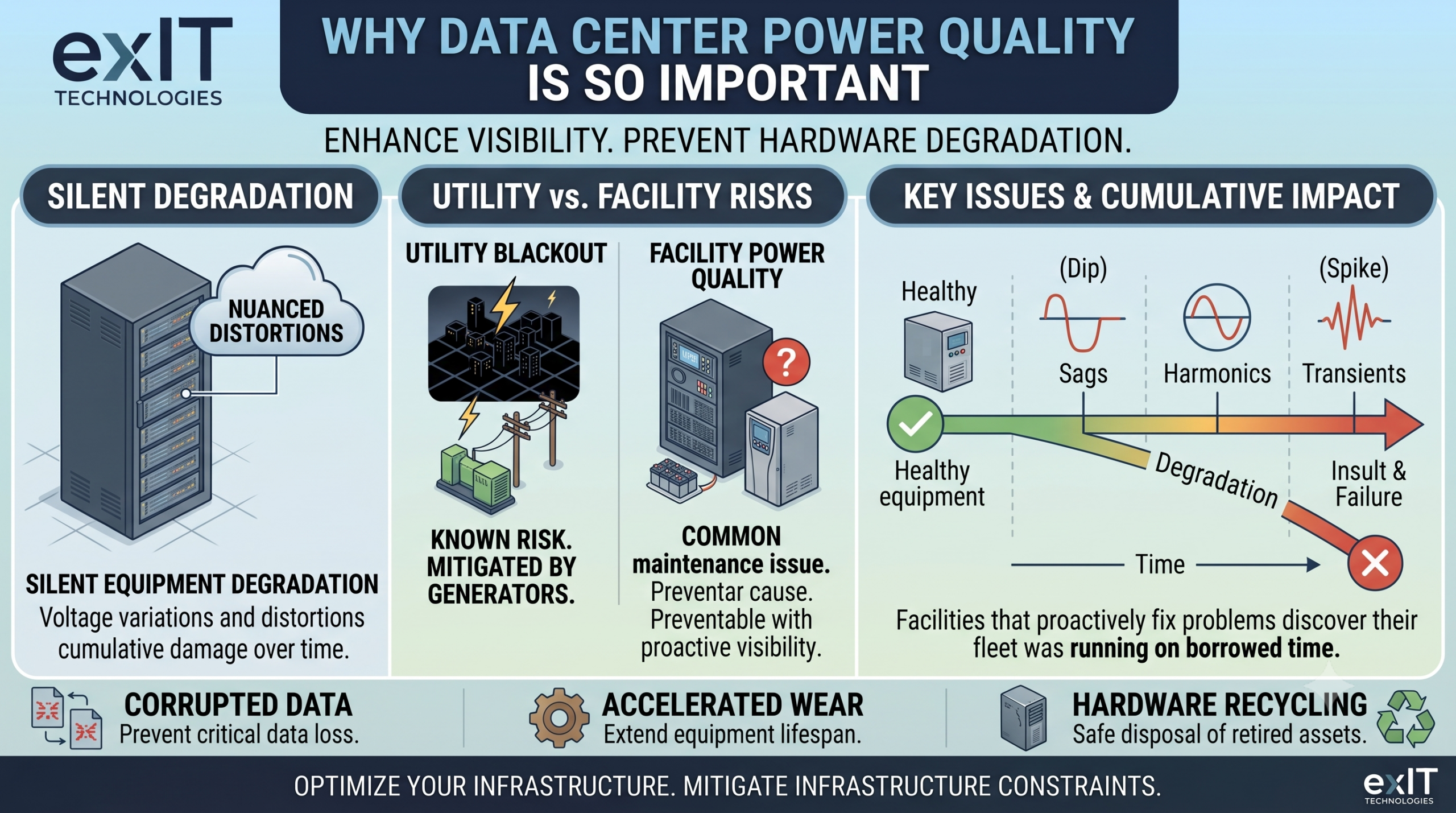
Half-second voltage sags due to low power quality can trip a variable frequency drive, corrupt an in-flight transaction, and force a controlled restart across a rack. Not a single alarm gets tripped on the monitoring dashboard.
By the time anyone traces the fault back to its source, the facility has already paid the price in corrupted writes and tripped drives.
Facilities spend heavily on generator capacity, UPS runtime, and N+1 configurations built around the assumption that the threat is a total loss of power. The more common failure mode is more nuanced: voltage that’s technically present but distorted enough to degrade equipment, corrupt data, or trip protective devices long before a true outage occurs.
Fast Facts: What You Need to Know About Data Center Power Quality
- Power problems remain the single largest cause of impactful data center outages, ahead of cooling, networking, or human error.
- Most power-related incidents trace back to UPS failures, not utility blackouts. The problem usually starts inside the facility.
- Harmonics, voltage sags, transients, and electrical noise can all degrade equipment and trigger downtime without ever registering as a full outage.
- IEEE 519 sets defined limits on harmonic distortion that data center teams should measure against with their power quality analyzer technologies.
- Continuous power monitoring is what catches these problems before they become incidents. Periodic testing won’t get you all the way there.
Why Data Center Power Quality Matters More Than Your Redundancy Specs
Uptime Institute’s most recent survey attributes 45% of impactful outages in 2025 to power issues, most often UPS failures (meaning it’s not a utility-side blackout). A grid failure is a known risk with a known mitigation: backup generation. A UPS failure caused by years of harmonic stress or an undetected voltage imbalance is a maintenance failure, and it’s usually preventable.
The financial exposure has kept climbing alongside the risk. More than half of operators in Uptime’s 2025 annual survey reported that their most recent major outage cost over $100,000, and for the second consecutive year, one in five reported costs exceeding $1 million. Power quality is a line item that shows up on the balance sheet, and you can’t just run a test once a year to say it’s up to your standards.
The Power Quality Problems Hiding Inside A “Healthy” Facility
A facility can pass every uptime audit and still be running on power that’s slowly damaging its own equipment. You’ll rarely find a tripped alarm from these harmful power quality issues:
| Problem | What Causes It | What It Does |
| Voltage sags | Motor starts, utility switching, weather events | Trips variable frequency drives (VFDs), resets sensitive electronics, forces controlled shutdowns |
| Harmonics | VFDs, switch-mode power supplies, LED lighting | Overheats transformers and neutral conductors, causes nuisance tripping |
| Transients | Lightning, switching operations, capacitor bank energizing | Damages semiconductor components, shortens equipment life |
| Electrical noise | Poor grounding, nearby non-linear loads | Interferes with sensitive control and monitoring circuits |
Harmonics deserve particular attention as data centers add more variable frequency drives and switch-mode power supplies to improve energy efficiency.
Every one of those devices pulls non-sinusoidal current, creating harmonic currents that can distort the power waveform. IEEE 519 caps individual voltage harmonics at 3% of the fundamental and total voltage distortion at 5%. It’s easy to overlook testing against that standard until a transformer starts running hot or a protective device trips.
How To Improve Data Center Power Quality
Fixing power quality after an incident is expensive and reactive. Fixing it before one happens can save you significant budget; it’s just a matter of maintenance discipline and maintaining visibility. Start with continuous power monitoring at the panel and PDU level.
A monitoring system that only samples power quality once a year will miss the transient that damaged a component eight months earlier. Real-time data lets your team catch a harmonic trend or a recurring voltage sag long before it causes a failure.
Pair that monitoring with a scheduled maintenance for UPS batteries, transfer switches, and generator systems, since UPS failure is the single most common root cause behind power-related outages.
Load balancing across phases reduces neutral conductor stress in facilities running a high density of single-phase, non-linear loads. Where harmonic distortion consistently runs close to IEEE 519 limits, that’s the signal to bring in an electrical engineer for a proper harmonic study.
The Dangers Of Ignoring Low Quality Power In Data Centers
Outages are just one consequence of poor power quality. Hardware degradation isn’t a five-alarm fire in the moment, but it can bring in major added expenses. Repeated voltage sags and harmonic stress shorten the working life of power supplies, capacitors, and the internal components of servers that were spec’d to run 5-7 years.
That accelerated wear rarely is a series of small failures leading to accelerated hardware refresh schedules. It’s not a single explosive event.
Facilities that finally get their power quality issues under control will discover exactly how much of their fleet has been quietly running on borrowed time.
If your team is already looking at which racks took the worst of it, exIT Technologies buys decommissioned servers if they have any value, and we can help you safely recycle them if they don’t.

 English
  German
  Spanish
  French
  Swedish
  Dutch
Dutch