

Data center monitoring teams are always working to prevent outages.
They look for hardware failure, thermal events, and other signs that an outage is imminent. Avoiding outages is so critical for data centers that monitoring for efficiency takes a back seat in the mindset of these teams. It shouldn’t.
Running a data center’s power distribution efficiently provides significant cost reduction. Power distribution units (PDUs) are the secret sauce that keep every rack in a data center operating off the right amount of power while protecting hardware from circuit overloads and excessive power density.
PDUs aren’t a set it and forget it technology. Data center operators need to understand what the technology can do and how to implement them before throwing PDUs all over their power sources.
Fast Facts: What You Need To Know About Power Distribution Units
- A PDU distributes electrical power from one input source to multiple devices in a rack. It is not the same thing as a power supply unit (PSU), which converts that power into a form the device can actually use.
- PDUs range from simple power strips to fully networked, outlet-level monitoring systems.
- Inefficient electrical distribution can waste 10-12% of total data center energy, and high-efficiency transformers close 2-3 points of that gap.
- Power Usage Effectiveness (PUE) is the standard efficiency benchmark, and PDU-level monitoring data is what makes calculating it possible in the first place.
What Is A PDU And What Does It Do In A Rack?
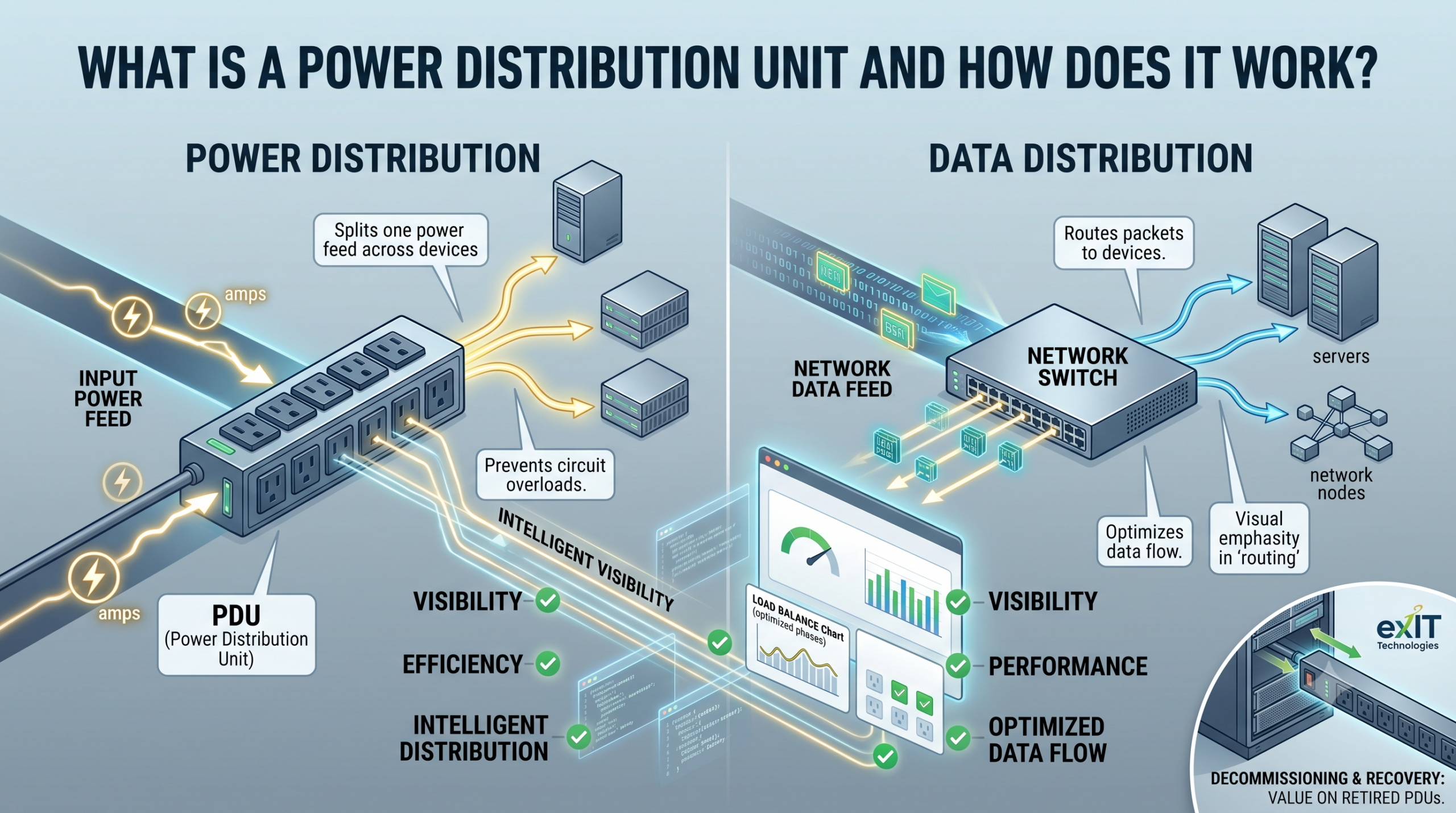
A power distribution unit takes one power feed and splits it across every device in the rack: servers, switches, storage arrays, whatever’s plugged in. Think of it as the electrical equivalent of a network switch, but instead of routing packets, it’s routing amps.
Most data centers run one PDU per-rack for standard workloads, and two for mission-critical racks. Each PDU is fed from a separate power source, so a single PDU or circuit failure doesn’t take the rack down. Racks running blade servers or GPU-dense compute often need more than one PDU regardless of criticality, simply because the current draw per rack unit is too high for a single unit to handle safely.
AI demand spikes have made the GPU-focused approach more important than ever. A rack of GPU accelerators pulls current at a rate that would have been unusual for an entire row a decade ago. If your PDU inventory was sized for 2018-era server density, it’s probably undersized for what’s actually plugged into it today.
How PDUs Work, From Power Strip To Networked Intelligence
Not all PDUs do the same exact job. The capabilities of your deployed PDUs determine whether you’re flying blind or watching every watt.
Basic PDUs. Unfiltered, unmonitored power strips built for rack mounting. They don’t manage data or support remote access. These are fine for a small closet, but a liability in anything you’re trying to run efficiently.
Metered PDUs. This model includes a digital display showing real-time load. You can see what you’re pulling, but nobody remote can see it with you and there’s no logging.
Monitored (intelligent) PDUs. With the next level of PDU, the devices report power data over the network, current, voltage, and often per-outlet consumption. However, you can’t switch outlets remotely.
Switched PDUs. These do everything a monitored PDU does, plus remote on/off control per outlet. This is the tier that lets you power-cycle a hung server from your desk instead of walking to the cage.
ATS (automatic transfer switch) PDUs. This unit has dual power inputs and fails over automatically if the primary source drops. It’s standard for single-corded equipment in redundant environments.
The floor-mounted PDUs upstream of all of this often carry isolation transformers that step high-voltage, high-current utility feeds down to the 120V/208V outlets your equipment actually uses.
How To Measure PDU Efficiency
You can’t manage what you don’t measure, and with PDUs, that’s not a cliché, it’s an actual gap in most facilities.
Start with PUE. Power Usage Effectiveness is the ratio of total facility power to the power actually delivered to IT equipment. PDU-level data is usually the input that makes this calculation possible at the rack level. A 2014 Uptime Institute survey put the industry average PUE at 1.7. Anything closer to 1.0 means less energy is being lost to overhead like distribution and cooling.
Check load balance. Unbalanced loads across the phases of a three-phase PDU create higher current flow between transformer legs, which shows up as waste heat and lower transformer efficiency. If one leg is running hot and two are idle, you’re paying for inefficiency that’s easy to fix.
Look at transformer grade. PDUs built with high-efficiency transformers run 2%-3% more efficiently overall than units with generic transformers. Over a facility’s lifetime, that’s a recurring utility bill difference.
Find and kill unloaded capacity. Redundant capacity you’re not using is still drawing overhead unless you shut it off. Target powered down two unloaded 300 kVA PDUs in one of its certified data centers and saved 261,000 kWh annually, according to the case study ENERGY STAR published on the project.
Watch the 80% rule. When sizing PDU load in North America, the sum of connected equipment wattage shouldn’t exceed 80% of the PDU’s rated capacity for continuous operation. Running closer to 100% removes your safety margin the moment one more blade gets racked.
The PDU Models That Data Center Teams Need To Know
If you’re shopping, the manufacturer list is short and mostly the same names your electrical contractor already knows:
- APC by Schneider Electric, Eaton
- Vertiv (Geist and Liebert lines)
- Raritan, Server Technology
- CyberPower
- Delta Electronics
- Aten
Each of these vendors covers the basic-to-switched spectrum described above, with pricing that climbs fast once you add outlet-level monitoring and DCIM integration.
Choosing a brand is important, but selecting the right tier of PDU is much more important. A colocation client running mixed-tenant racks needs metered or monitored units at minimum, for billing accuracy alone. A hyperscale or AI compute environment running GPU-dense racks needs switched, high-density PDUs with three-phase input and outlet-level remote control. The cost of an unplanned outage on that hardware dwarfs the price difference between PDU tiers.
Retiring PDUs With The Rest Of Your Data Center Hardware
Here’s the part most PDU conversations skip entirely: these units have a second life cycle nobody plans for. When a rack gets decommissioned, whether it’s a colocation exit, a hardware refresh, or a full data center closure, the PDU comes out with everything else.
It still has resale value, it may still be under warranty, and depending on what’s logged in its monitoring history, it may carry data that needs to be handled the same way a drive does.
Most teams plan meticulously for what happens to the servers in a decommission and treat the electrical infrastructure as an afterthought. That mindset will leave value on the table.
If your next data center project involves pulling equipment out, not just plugging it in, exIT Technologies’ data center decommissioning services handle the full rack, PDUs included, with the same chain-of-custody documentation you’d expect for a server full of customer data.

 English
  German
  Spanish
  French
  Swedish
  Dutch
Dutch