

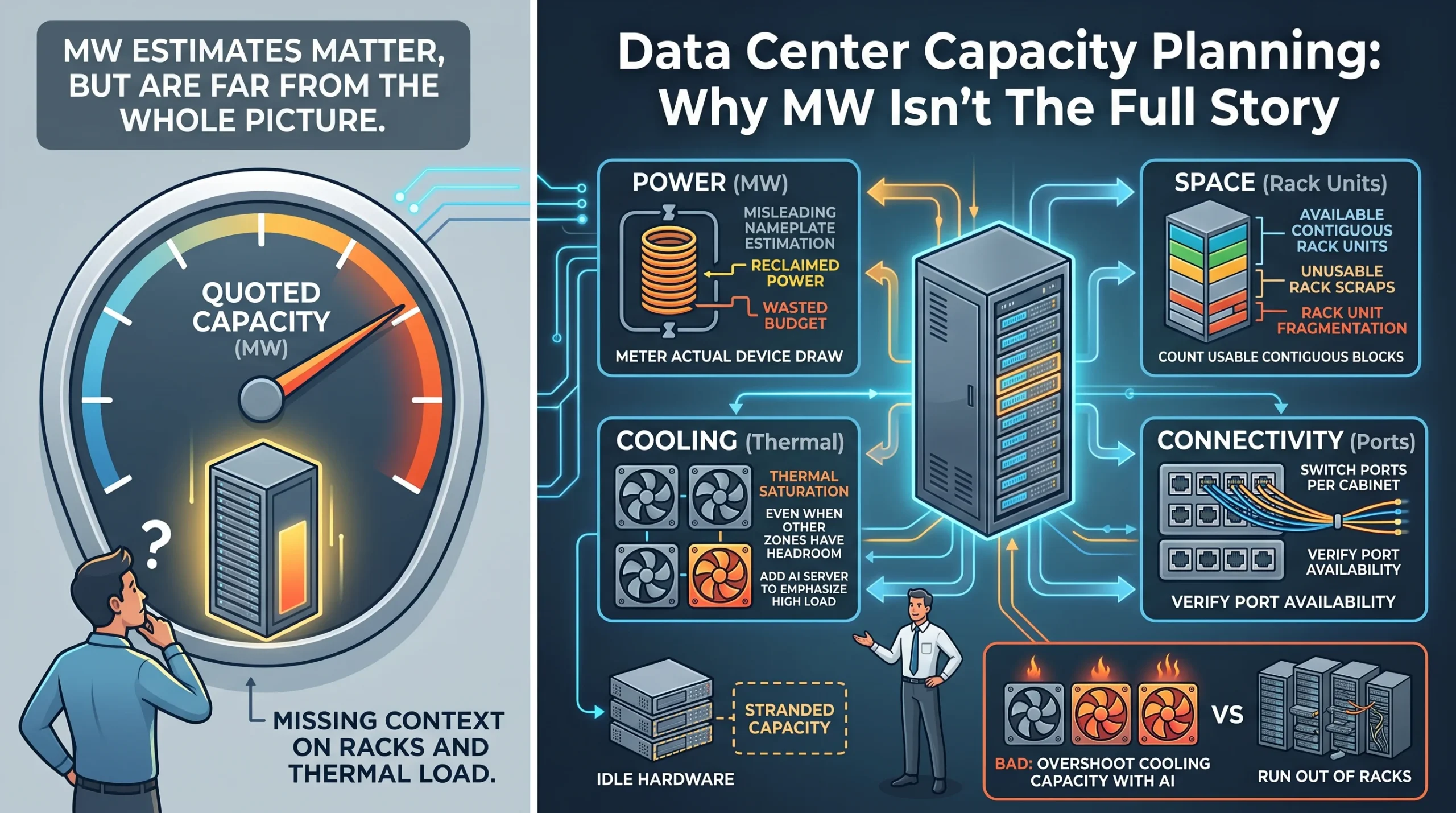
Data center capacity gets quoted as a single number, usually in MW, because a single number is easy to put in a lease. MW estimates matter, but it’s far from the whole picture.
You’re missing context about the amount of racks a facility can support or the thermal load that the building can handle. In practice data center capacity is broken into four separate numbers that rarely hit their ceiling at the same time.
Without the full picture, you can overshoot your cooling capacity with AI servers, or run out of racks due to a high number of servers running a low, steady output.
Fast Facts: What You Need To Know About Data Center Capacity Planning
- Capacity isn’t one metric. Power, floor space, cooling, and port connectivity each have their own ceiling.
- MW hides density, cooling headroom, and fragmentation problems that MW alone can’t show you.
- Nameplate derating (the old 70% rule of thumb) routinely wastes 20-40% of your real power budget.
- Idle and decommissioned hardware draws budgeted power and occupies rack units without doing any work.
- Duke’s Nicholas Institute found flexible demand management could avoid $40-$150 billion in electricity generation spending over the next decade. The same logic that applies inside your own four walls.
4 Numbers That Contribute To Data Center Capacity
Ask a data center manager how full their facility is and you’ll usually get a power percentage. That’s not the whole picture.
Real capacity has four independent dimensions:
- Power: what the electrical infrastructure can deliver
- Space: rack units and floor area
- Cooling: thermal headroom per zone
- Connectivity: copper, fiber, and switch ports available per cabinet
A facility can sit at 60% power utilization and still be functionally full, because the cooling loop in one pod is saturated. The available rack units could also be scattered across the floor in pieces too small to fit a new deployment. That’s called rack unit fragmentation, and it measures whether your free capacity exists in usable contiguous blocks or in scraps spread across dozens of cabinets.
A facility can report 30% open capacity and still be unable to land a single new high-density rack, because no individual cabinet has enough contiguous space or power budget to take it.
Why Everyone Quotes Capacity in Megawatts, And Why That Isn’t The Full Picture
MW became the industry’s shorthand because it’s the one number that compares cleanly across sites of wildly different age, layout, and design. A 10 MW facility and a 100 MW facility can be ranked instantly, no site visit required.
The problem is that MW measures potential draw, not usable capacity. Two facilities rated at 20 MW can support completely different amounts of actual compute, depending on rack density, PUE, and how much of that power budget is already stranded in cooling overhead or idle equipment.
For a buyer or tenant, that gap matters. A quoted MW figure doesn’t tell you what’s already parked on that power budget doing no work.
You Might Be Paying For Capacity You’re Not Using
Most of the missing capacity is “reserved” and never reclaimed.
The traditional method for power capacity planning derates a server’s nameplate rating to roughly 70% and budgets accordingly. This approach can get you answers quickly, but that doesn’t make it right.
It assumes every device is drawing near its maximum simultaneously. When you actually measure it, the load is almost always lower. Facilities that switched to metering actual device draw instead of nameplate estimates have reported power utilization improvements as high as 40%. There’s no new power draw here. Operators are just using what has already been budgeted.
Idle and decommissioned hardware compounds the problem. A server that’s been powered off but never removed still occupies rack units and in a lot of environments it still holds a reserved slot in the power budget. Multiply that across a few racks of retired GPU nodes from a cancelled project or a refresh cycle that never got closed out, and you’ve got real MW and rack units sitting stranded on paper capacity that was never actually reclaimed.
You can’t fix that with better dashboards alone. It’s a physical problem, and the hardware has to actually leave the building before the capacity comes back.
Efficient Data Center Capacity Planning Is Just As Important As Power Capacity Increases
Zoom out to the grid level and the same logic shows up at a much bigger scale. Duke University’s Nicholas Institute modeled what happens if data centers get even modestly flexible about when they draw peak power, shifting some workloads across hours and regions instead of always pulling maximum load. They found that flexibility alone could avoid $40- $150 billion in new generation investment over the next decade, and shifting the mix of new power plants toward renewables instead of gas peaker plants can cover data center demand spikes.
A meaningful share of the “shortage” is an allocation problem instead of a supply problem. It’s cheaper to fix by using existing capacity more efficiently.
Inside your data center, that means the fastest capacity you can add this quarter probably doesn’t involve a new circuit. Check your rack units and power budget currently locked up by hardware that stopped doing useful work months ago.
If retired hardware is sitting in your racks holding capacity hostage, you can find out what it’s actually worth to have it gone: exIT Technologies’ data center decommissioning services handle the pickup, certified data destruction, and asset recovery in one pass, so the capacity comes back the same week the gear leaves the floor.

 English
  German
  Spanish
  French
  Swedish
  Dutch
Dutch