

Most published guidance on GPU procurement stays on the quote: lease vs. buy vs. rent, and the utilization rate at which each one wins.
Servers that arrive at a cage wired for half their draw, secondary-market lots with no transferable warranty, and clusters bought with no view of resale value all can turn out to be big mistakes.
Fast Facts: What You Need To Know About Staggering GPU Purchases
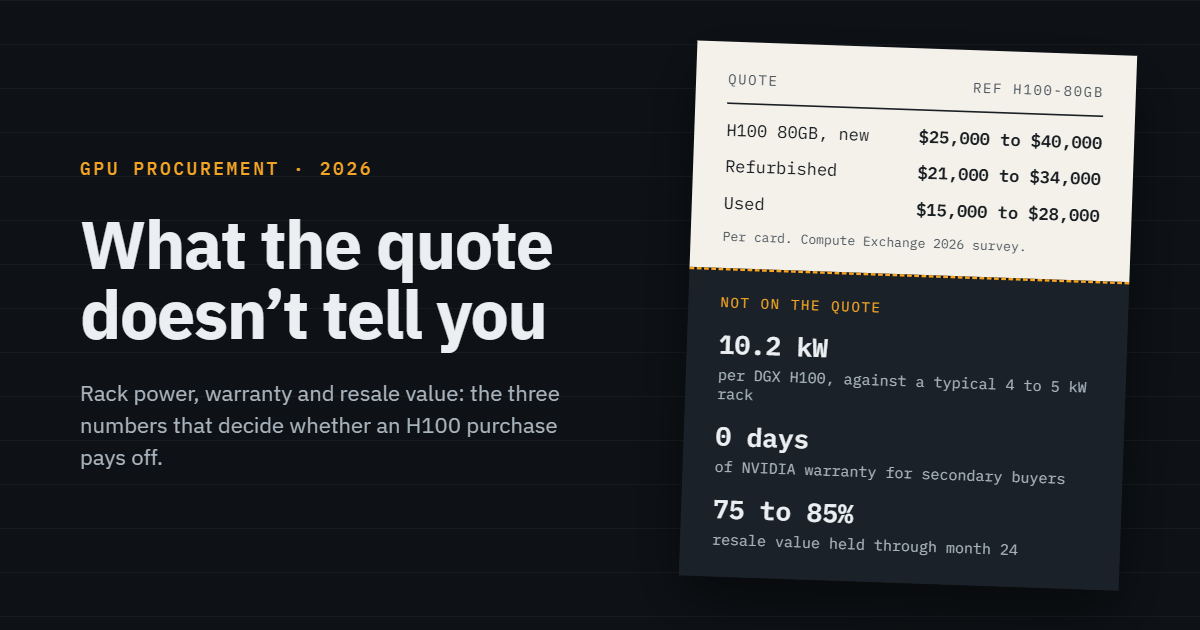
- An 8-GPU DGX H100 draws up to 10.2 kW, and the most common rack density in Uptime Institute’s 2026 survey is 4-5 kW, so confirm per-rack power and cooling before you commit to a delivery date.
- Utilization decides whether you should own at all. Compute Exchange puts the break point around 60% sustained utilization, below which renting beats every ownership path.
- Refurbished H100s list at roughly 80-85% of new and used units at 60-70%.
- NVIDIA’s manufacturer warranty does not carry over to secondary buyers, so the seller’s written warranty and test records are the only coverage you get.
- Write the resale date and expected resale value into the purchase decision to avoid sudden shocks to hardware budgets and valuation.
Every GPU Procurement Channel Has Its Own Weakpoints
The channel you buy through sets your price, your wait, and the kind of problem you inherit. Compute Exchange’s 2026 H100 price survey puts new 80GB cards at $25,000-$40,000, refurbished at $21,000-$34,000, and used models at $15,000-$28,000.
| Kanal | Fits when | What you give up | Check before you sign |
| New, from NVIDIA partner or OEM | You’ll run the hardware for years at high utilization and need the current generation | A place in the allocation queue, since NVIDIA reports supply constraints | A committed ship date in the contract, written as a date |
| Hyperscaler, reserved or on-demand | Demand is bursty or unproven | Any asset at the end of the term, plus egress fees on data you move out | Commitment length and egress pricing |
| Specialist GPU cloud or bare metal | You need capacity in days | Control over the provider’s finances and hardware choices | Who owns the hardware, and what the SLA pays when it fails |
| Refurbished, secondary market | A 6-24 month horizon of steady inference | Nvidia’s warranty; seller coverage runs 90 days to 2 years | Burn-in report and a written warranty |
| Used, through brokers | You have in-house diagnostics and spare capacity to absorb failures | Warranty and, often, documentation | Serial-level provenance before payment |
Utilization decides the first fork. Compute Exchange’s analysis puts the line near 60% sustained: below it, renting beats owning new or refurbished hardware, so a team that can’t commit to that floor for the next 12-24 months should stop pricing servers. Above that line, the refurbished discount looks thin for a part that shipped in 2023. The value of buying refurbished is mostly calendar time, since a racked and tested unit this month beats a new one at the back of an allocation queue for any inference workload that can’t wait.
Rack Density Decides Your GPU Order
NVIDIA’s DGX H100 documentation rates the system at 10.2 kW maximum, fed by six 3.3 kW power supplies in a 4+2 redundant layout at 200 to 240 volts. NVIDIA notes the system keeps running at reduced performance if three supplies lose power. In practice, a rack that can land only four cords per server runs at full speed with no redundancy, and one that can land three runs throttled.
The Uptime Institute Global Data Center Survey 2026 found the average typical rack density passed 11 kW for the first time, but only because a few new high-density sites pulled it up. Without those sites the average is 7.8 kW, and 4-5 kW is still the most common band, reported by roughly three in ten operators.
Two DGX H100s in one rack draw up to 20.4 kW. That’s about four times a 5 kW rack and roughly 2.5 times the 7.8 kW typical rack outside the dense sites, before you add switches and storage.
Rack-scale Blackwell systems such as GB200 NVL72 move the constraint from electrical capacity to plumbing, since they’re designed for direct liquid cooling. Before a purchase order goes out, get these in writing from your facilities team or colo:
- Contracted kW per rack at the density you plan to run, plus the cooling method that supports it.
- Circuit count and voltage for every power supply in every server, at full redundancy.
- The completion date for any power or cooling upgrade, set against the hardware delivery date.
Verify The Serial Number, Then Verify The Silicon
SERI’s R2v3 standard bars certified facilities from sending lost, stolen, counterfeit, or recalled equipment back into reuse, which tells you how the legitimate downstream ma
rket treats hardware whose history can’t be shown.
Before you pay a secondary-market seller, get these:
- A serial-level manifest for every GPU, baseboard, and chassis, which you reconcile against the physical units on arrival.
- Part numbers matched to the configuration you ordered. The H100 PCIe card enables 114 streaming multiprocessors against 132 on the SXM5 module, so a form-factor swap is a performance downgrade.
- A burn-in report under sustained load with per-GPU memory and NVLink results. Nvidia’s Data Center GPU Manager (DCGM) includes a diagnostic suite you can rerun yourself when the hardware lands.
- Firmware and VBIOS versions for each unit, so you know how much fleet cleanup you’re buying along with the cards.
- A written warranty from the seller, since NVIDIA’s warranty does not transfer to secondary buyers, plus proof of the seller’s test-and-repair process.
Price The exIT On The Day You Purchase
Resale value belongs in the purchase decision because it’s the largest number most TCO models leave blank. Compute Exchange reports refurbished H100s holding 75-85% of acquisition value through month 24, and it expects Blackwell availability to push H100 secondary prices down another 10-20%. Earlier forecasts called for far steeper declines.
Two decisions at purchase protect the number:
- Set the target exit month now and tie it to a specific trigger, such as the delivery date of your next-generation cluster.
- Keep every document you demanded as a buyer (serial manifests, burn-in reports, firmware records), because the next buyer will ask you for the same file.
Teams that start building that file on the day the purchase order goes out are the ones who get a real number back.
If you’re pulling Hopper or Ampere systems to make room for Blackwell or Rubin, exIT Technologies prices data center GPUs against current secondary-market demand and handles the decommission, drive sanitization, and serial-level documentation your buyer will expect. See what your data center GPUs are worth.

 Swedish
 English
 German
 Spanish
 French
 Dutch