

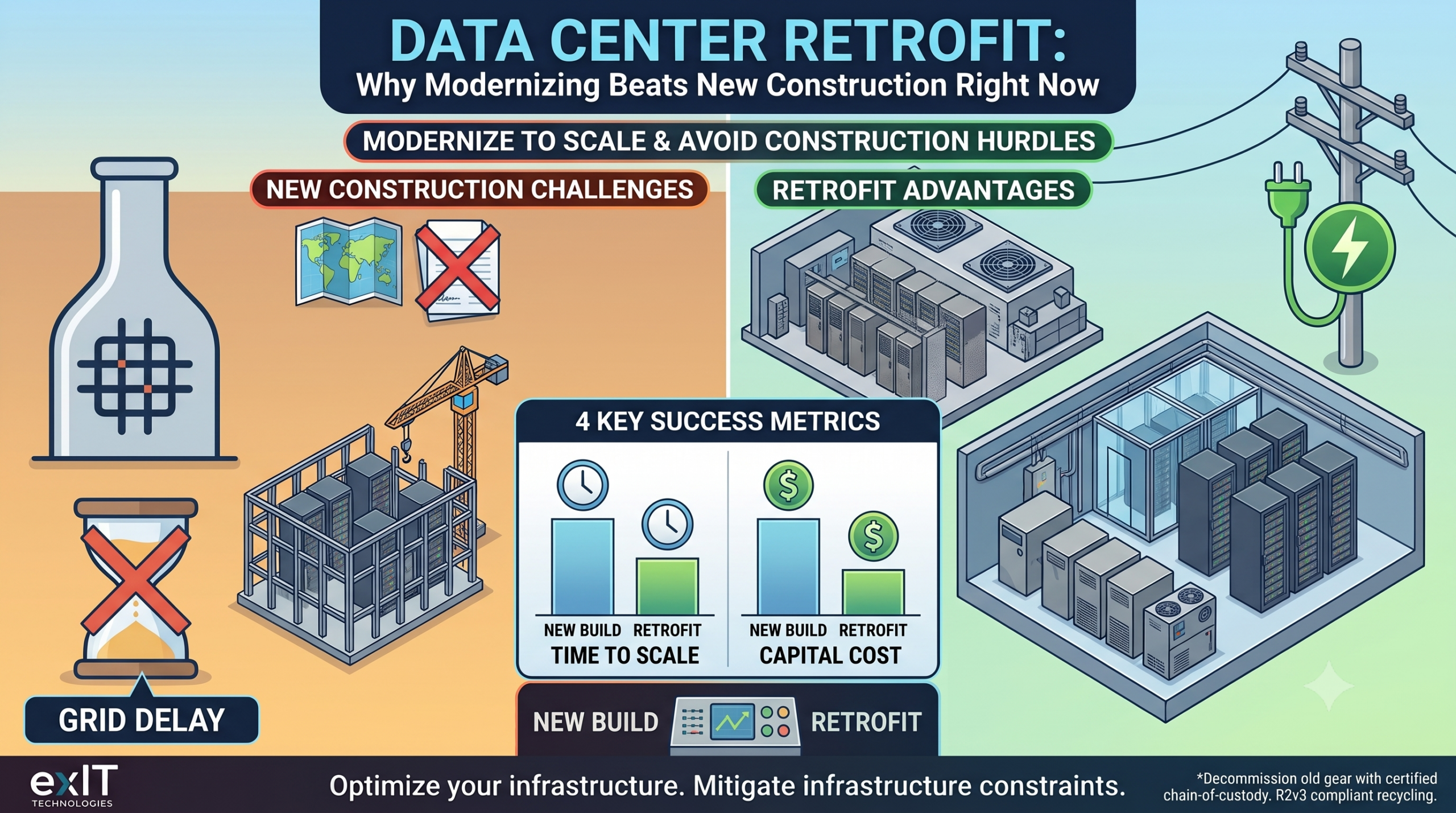
Every operator evaluating capacity expansion right now faces the same fork: build new, or modernize what’s already standing.
New construction means fresh land, fresh permits, and a place in a grid interconnection queue that now stretches years in most major markets. A data center retrofit simplifies all three by upgrading the power, cooling, and layout of a facility that already has them.
The market factors and the math increasingly favors the data center retrofit approach.
Fast Facts: What You Need to Know Retrofitting A Data Center
- Roughly half of all data centers are more than 10 years old, and that older tier holds 38% of the world’s installed IT capacity, as of 2024.
- With growing barriers to new data center facility construction, retrofitting existing data centers becomes more attractive because the permits, building itself, and grid allocation are already in place.
- Cooling accounts for 30-40% of total data center energy use, making it the single largest controllable cost in an aging facility.
- U.S. data center electricity use is projected to climb from 4.4% of national demand in 2023 to as much as 12% by 2028, adding pressure to squeeze more capacity out of existing footprints.
- The hardest part of a retrofit is usually sequencing the work without taking a live facility offline.
Why People Choose Retrofitting Data Centers Over New Construction
Land and power are the two hardest things to get for a new data center site, and both are only getting harder. Interconnection queues in major U.S. markets now stretch years before a new facility gets a grid connection large enough to matter.
A retrofit skips that line entirely. The site already has utility service, an existing footprint, and, in most cases, a permitting history the local jurisdiction has already worked through once. What’s left to solve is inside the fence: undersized cooling plants, legacy switchgear, and rack layouts designed for a density profile that’s a decade out of date.
The U.S. Department of Energy projects that data centers could consume between 6.7% and 12% of national electricity by 2028, up from 4.4% in 2023. Every percentage point of that growth has to come from somewhere.
Building new capacity fast enough to cover it is proving difficult. However, recovering capacity that’s already sitting idle inside an inefficient decade-old shell is not.
4 Metrics That Define The Success Of A Retrofit
A retrofit is only worth the upheaval if it tilts specific numbers. Improving the following four metrics is the key to an effective data center retrofit project.
- Power Usage Effectiveness (PUE). Cooling accounts for 30%-40% of total data center energy consumption, more than any other controllable load in the building. Replacing legacy CRAC and CRAH units, adding containment, and rebalancing airflow typically produces the largest single PUE improvement available in an existing facility. The equipment being replaced was specified against thermal loads that are completely outdated.
- Rack density headroom. Racks designed a decade ago rarely support today’s power and cooling demands per cabinet. A retrofit that upgrades power distribution and cooling capacity in place raises the ceiling on what a given footprint can actually run. This will only matter more every year, as compute density climbs.
- Useful life extension. A facility approaching the end of its 10-to-15-year design life either gets decommissioned or gets a second decade of service. Retrofitting the electrical and mechanical systems is almost always cheaper than the land acquisition, permitting, and construction cost of a replacement facility.
- Operating cost per kilowatt. Lower PUE and modernized power distribution reduce the utility bill per unit of IT load delivered, which is the number that ends up in front of the CFO. Determine how the retrofit will alter this figure before asking what it does to anything else.
How to Plan a Data Center Retrofit Without Taking the Facility Offline
Planning starts with an honest audit. Document current power capacity and headroom, cooling architecture and age, and the structural load rating of the floor (since higher-density racks weigh more than the ones they’re replacing).
Sequencing matters more in a retrofit than in new construction because the facility usually can’t go dark while the work happens. Most retrofit plans move in phases: new power feeds get installed alongside the old ones, cooling upgrades happen zone by zone, and workloads migrate in the gaps between phases when it’s safe to do so.
That sequencing only works if facilities, operations, and account management are aligned from day one. A retrofit team walking into a live facility is a guest in someone else’s operating environment. The migration plan has to reflect that constraint as much as it reflects the engineering.
Challenges That Come With Retrofitting A Data Center
Retrofits are frequently harder to execute than new builds, even though they start with more in place. The facility already has customers, live workloads, and operational commitments that a greenfield site doesn’t carry. You’re operating within existing architecture, rack measurements based on old hardware, and cooling systems.
That lack of control leads to greater logistics challenges and limitations on your design choices.
Right-sizing is the other place that plans go wrong. It’s common to over-specify redundancy and cooling capacity out of habit rather than actual load requirements, which erodes the efficiency and cost gains a retrofit is supposed to deliver. A retrofit plan cannot just replicate the original design at higher capacity.
Next Steps After The Data Center Retrofit
The interconnection queues for new grid capacity aren’t getting shorter, so the facility that’s already standing, plugged in, and permitted may be the fastest path to scale. The equipment coming out during that upgrade, though, doesn’t just disappear.
Legacy UPS units, cooling motors, switchgear, and the servers being replaced with higher-density hardware all still need to leave the building, and most of them are still carrying data. exIT Technologies handles the Avveckling av datacenter side of a retrofit, including chain-of-custody tracking, certifierad datadestruktion, and R2v3-compliant recycling for everything coming off the floor.

 Swedish
  English
  German
  Spanish
  French
  Dutch
Dutch