

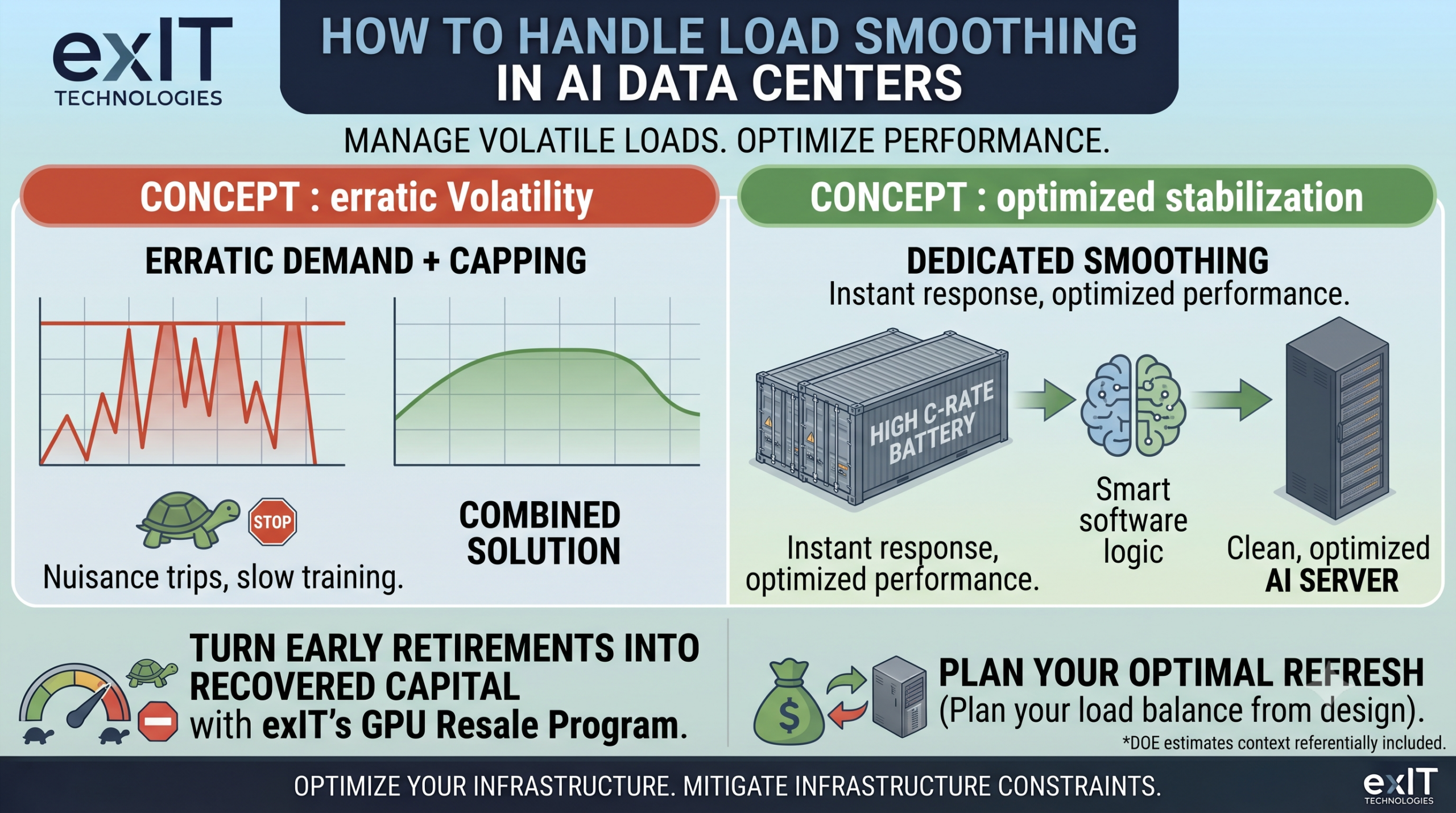
A frontier AI training run doesn’t pull power steadily from the grid .
Thousands of GPUs go idle and active in near-lockstep, so demand can swing from a near-flat baseline to a spike of 100+ megawatts in less than a second. And this happens multiple times a minute.
Gas turbines, transformers, and switchgear were built around slow, predictable load changes, but they’re being asked to deal with sudden, dramatic shifts. That is why load smoothing is becoming more and more important, as power management is perhaps the hardest engineering challenge that comes with AI infrastructure.
Fast Facts: What You Need to Know About Load Smoothing
- Modern AI training clusters can swing power demand by 100 MW or more within sub-second windows, a profile that gas turbines and grid infrastructure weren’t designed to absorb
- Standard grid-scale battery systems are largely the wrong tool for this job. Load smoothing needs high C-rate batteries built to flip between charging and discharging hundreds of times a day, not slow, high-capacity storage.
- Software-based smoothing is emerging as a complement to hardware.
- Facilities that can’t smooth electrical loads are left with one option: power-cap the GPUs and run conservatively, which shows up as either higher operating cost or lower training throughput
- The DOE estimates 100 GW of additional U.S. generating capacity will be needed by 2030, with roughly half of that driven by data centers, which is why load profile shapes procurement and hardware refresh decisions.
The Grid Wasn’t Built For AI Data Center Workloads
Traditional data center load is so simple that it can be boring. Utilization moves in hours, not milliseconds, and generation assets can ramp to match it.
AI training breaks that assumption completely.
GPUs in a synchronized cluster spend part of their cycle computing and part of it waiting at a synchronization point, like an all-reduce operation, and thousands of them wait together.
The result is nothing like the usual data center curve. Instead, it’s more like a switch flipping on and off. Multiply that across a full cluster, and the swing shows up first at the rack, then at the facility, then at the utility interconnect.
Gas turbines, in particular, operate most efficiently in a narrow load band, and even advanced droop control can’t track frequency changes that fast. Left unmanaged, the strain shortens turbine life and raises the risk of a full system trip.
Operators need to know what their existing and planned facilities is actually built to absorb: an hourly ramp, or a swing that happens forty times a minute?
Standard Batteries Can’t Fill The Load Smoothing Gap
Battery energy storage looks like the obvious fix, and it can be, but not the kind most facilities already have. Grid-scale BESS (battery energy storage system) is designed for long-duration jobs: shifting renewable output, frequency regulation over minutes to hours, peak shaving on a predictable schedule. Those systems typically run around a 0.5C rate, meaning a depleted 1 MWh battery needs roughly two hours to recharge.
Load smoothing needs the opposite profile: high charge and discharge rates, rapid cycling hundreds of times a day, and less concern with total energy capacity, since the swings themselves rarely last long. Marine-grade batteries, originally built for ship propulsion and offshore platforms with similarly volatile loads, are now being adapted for this exact use case, running at roughly 2C charge and 4C discharge rates instead of 0.5C.
Get the C-rate wrong, and you’ll make things worse. That’ll lead to more containers, more footprint, more thermal management overhead, and faster cell degradation from the very cycling pattern you installed the batteries to handle.
How Software Can Ease The Burden Of Load Balancing
Hardware fixes are expensive and slow to validate across a fleet. That’s pushed some operators toward a second layer: software that smooths power without touching the electrical infrastructure at all.
The tolerances are tight. Miss an idle window by more than a few milliseconds and you’ll lose most of the benefit. React too slowly on the way back up, and you’ll steal cycles from the training job itself. During training, a small delay turns into a significant cost quickly. Software smoothing buys you some extra time and is easy to deploy, but it doesn’t replace batteries or turbine design.
What Happens When You Don’t Smooth Your Data Center Load
If operators can’t find a creative solution, they default to the conservative option: cap GPU power draw and run the facility below its real ceiling until the load profile is proven well-behaved. That conservatism comes with a price.
It shows up as a slower training run, a higher power bill per token, or a rack of GPUs that gets pulled and swapped out for more power-efficient hardware well before it actually failed.
When the constraint is the electrical layer rather than the chip itself, the fastest lever to pull is the hardware in the rack. The external substation isn’t so easy to alter.
Planning Your Load Balance With Hardware Capacity In Mind
None of this gets solved by picking a battery vendor first. Treat load smoothing as a fundamental aspect of your architecture from the first design meeting. It’s not a component you bolt on after the fact. With this system as the cornerstone of your plans, the rest of the decisions are easier to make in the right order.
If your facility is already power-capping GPUs or shortening refresh cycles to stay inside a power budget, the hardware coming off those racks still has resale value. exIT’s GPU resale program turns early retirements into recovered capital instead of a write-off

 Swedish
  English
  German
  Spanish
  French
  Dutch
Dutch