

Your data center migration plan is finalized and everyone is satisfied with the structure. The new environment is ready, and the cutover window is set. Then someone asks about the decommission plan.
One person thought it was already taken care of. Another person suggests you “outsource it,” without going into detail. Then someone suggests you wait until the migration is complete.
That’s where the trouble can begin.
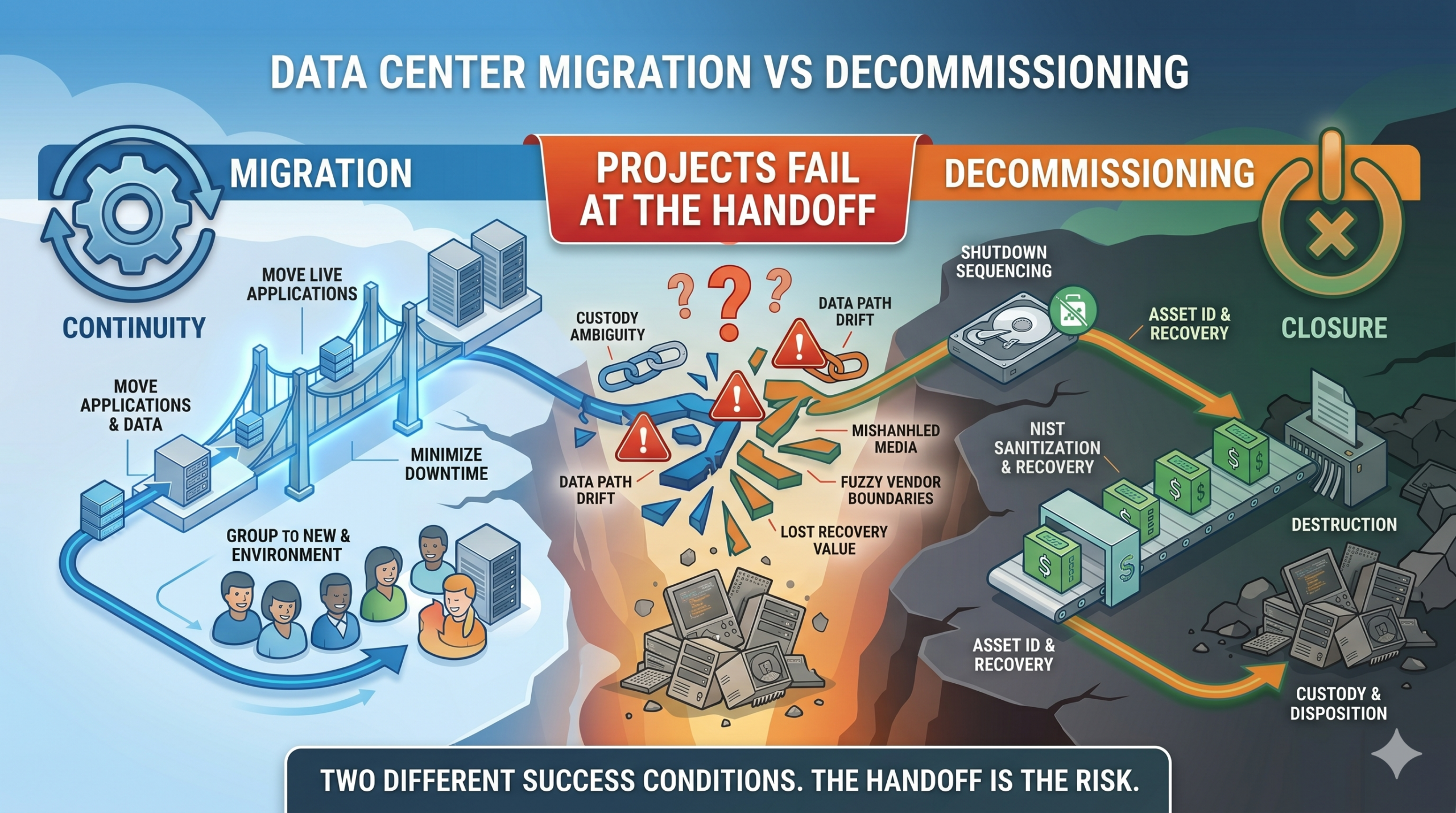
Migration and decommissioning aren’t the same project, but they’re closely related.
When teams collapse them into one mental bucket, the migration gets treated like a technology event and the decommission gets treated like leftover logistics.
That’s how asset recovery disappears, chain-of-custody gaps open, and the ugly work gets discovered when leadership thinks the project is already basically over.
Migration and Decommissioning Solve Different Problems
The cleanest way to understand the challenges you can encounter is by separating the jobs.
| Migration is about continuity It’s about getting workloads, applications, users, dependencies, and infrastructure state from one environment to another without breaking the business. | Decommissioning is about closure It’s about proving what happened to the old environment after the migration no longer needs it. That includes shutdown sequencing, asset identification, chain of custody, removal, sanitization, recovery, destruction, recycling, and final reporting. |
Those are different success conditions.
A migration can be technically successful even if decommission becomes a financial, compliance, or evidentiary mess. A decommission can be tightly run while the migration plan itself was sloppy. The overlap is real, but it is a handoff, not a merge.
The Handoff Zone Presents Logistics Challenges
If a team fails, it’s because nobody owns the handoff between the live environment and the retired one.
That handoff zone is where the potential for catastrophe is greatest. If you can’t answer these questions, things will get dangerous:
| When is the asset truly out of production? | Who authorizes removal? | Who confirms data-bearing media is in the right path? |
| Who owns the final inventory? | Who decides what is recoverable versus destruction-grade? | Who reconciles what was supposed to move with what actually moved? |
If those questions do not have named owners before the migration window closes, the project starts improvising.
Improvisation creates the exact kind of problems that you want to avoid: custody ambiguity, missing serialization, poor recovery handling, and unexpected cleanup work. While everyone’s celebrating the migration, the decommission is falling apart.
What Migration Owns and What Decommissioning Owns
These are the operations that teams should explicitly outline before execution:
| Workstream | Migration owns | Decommissioning owns |
| Workload cutover | Application move, validation, rollback logic | N/A |
| Production shutdown | Confirming systems are no longer needed in the old environment | Enforcing removal only after approved shutdown state |
| Inventory state | Identifying what remains live versus retired | Capturing final serialized inventory of retired assets |
| Data risk | Protecting live data during cutover | Sanitization, destruction, and evidence after retirement |
| Financial outcome | Avoiding downtime cost | Preserving resale value and controlling removal / destruction cost |
| Final reporting | Migration completion and service restoration | Custody records, disposition records, recovery, and closeout |
This table is intentionally simple.
Operators tend to overcomplicate the boundary in discussion and under-define it in execution.
Five Failure Points That Cause Projects To Break Down
Most issues with data center decommissions and migrations come down to a few specific areas.
1. The Old Environment Gets Treated Like a Storage Problem
This is the most common post-migration mistake. The migration finishes, but the retired environment is still sitting there in a gray zone. Nobody wants to touch it until everyone is sure the cutover is stable. That caution is understandable, but it creates drift.The longer the old environment stays in limbo, the more likely you are to lose clean inventory state, mix working assets with dead ones, mishandle media, or let recovery-grade hardware age into a worse market.That is why decommissioning cannot be the project that starts after everyone feels relaxed. It needs a defined entry point, even if execution happens in controlled phases after cutover.
2. Nobody Defines the Last Trusted Inventory
Migration teams are usually focused on service state, not residue state. They know what got moved. They are usually less disciplined about what stayed behind, what was powered down, what still held data, and what changed condition during the project.That is where the decommission starts losing money and control. If you do not lock the final retired inventory at the right moment, each conversation gets weaker than the last: what can be recovered, what must be destroyed, what was actually removed, and what is still missing from the record.The later you try to reconstruct that list, the more your project starts depending on spreadsheets that aren’t aligned.
3. The Data Path Gets Designed Too Late
Migration teams often assume the old environment can be sanitized once the move is done. That’s a placeholder, not a planBy the time the placeholder turns into real work, the assets may already be mixed and the custody conditions may be weaker. Then the decision about reuse versus destruction comes down to schedule pressure instead of policy pressure.
NIST SP 800-88 Revision 2 is useful here because it frames sanitization as a program with controls tied to media type and information sensitivity. The data path needs to be decided as part of the decommission design. You can’t simply cross that bridge when you come to it.
4. The Recovery Plan Is Either Fantasy or Neglect
Teams usually swing too far in one direction. Either they assume the retired environment is a hidden gold mine, or they treat everything old as scrap and accidentally destroy value.Both mistakes come from the same problem: Nobody did the work of separating premium inventory from tail inventory.
If the decommission plan does not identify what has real secondary-market demand, the hardware gets handled like cleanup instead of like an asset class. If the plan assumes everything still has value, finance gets sold a fantasy and the project budget gets distorted before execution even starts.
5. The Vendor Boundary Is Fuzzy
A migration vendor, move team, facilities contractor, and ITAD operator can all touch the same project. That does not mean they share the same incentives.
One party wants the cutover stable. Another wants the room cleared. Another wants the hardware serialized and protected. Another wants the recovery outcome preserved.If those boundaries aren’t defined, the project defaults to whoever is loudest in the final week. The decommission owner needs authority over the retired asset path even if migration owns the cutover.
A Better Operating Model
If you want the project to stay clean, run migration and decommissioning as linked but separate workstreams with a formal handoff.
That handoff should define:
- Final inventory: Trusted end-state inventory
- Recovery Plan: Resale-grade hardware strategy
- Pensionering: The moment an asset is retired
- Closeout Owner: Owner of the closeout record
- Sanitization: Data destruction or sanitation path
Five Questions to Force the Right Conversation
Before the migration closes, ask:
- Who owns the retired inventory once cutover is complete?
- What is the last trusted asset list, and when is it locked?
- Which assets are recovery-grade, destruction-grade, or still in exception?
- What is the custody path from retirement through final disposition?
- Who signs the final decommission closeout package?
If the answers are vague, you’ll need to sort that out before the process begins.
The move may be ready. The workloads may be stable. The new environment may be humming. That still doesn’t mean the project is under control.
A migration ends when the business is live on the new side. A decommission ends when you can prove what happened to the old hardware. The projects fail when teams confuse those two finish lines.

 Swedish
  English
  German
  Spanish
  French
  Dutch
Dutch