

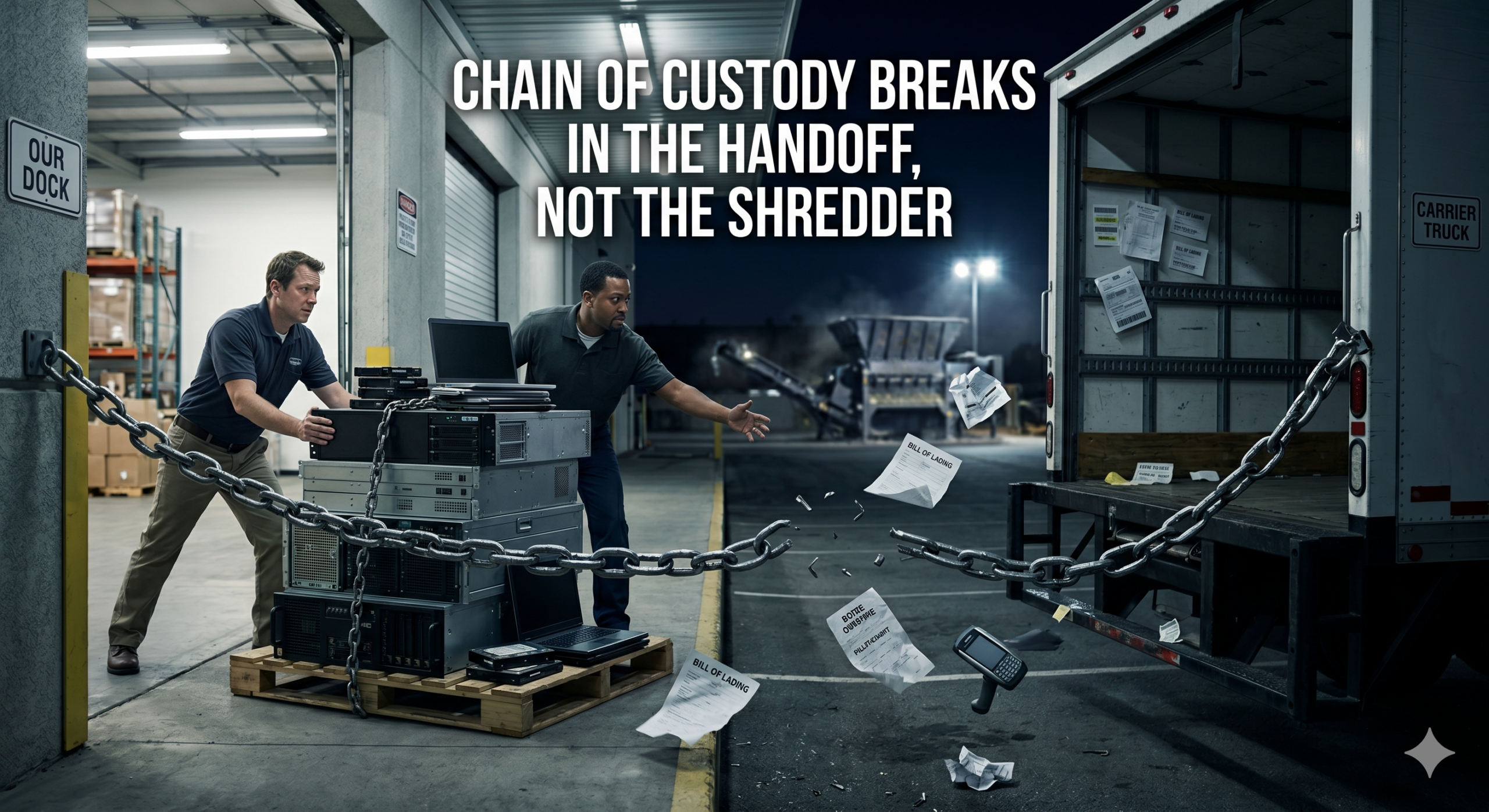
It’s 10pm, do you know where your decommissioned storage hardware is?
What about the proprietary and customer data stored on it? Business leaders need to answer these questions to meet compliance standards and avoid a disastrous data breach.
Lots of people think that a decommission is a straightforward shipping task where people come to your business and take your IT hardware. In reality, the process begins long before anyone takes your gear and you need to closely follow who has control of it.
The Risk Starts Before the Destruction Event
Nach Angaben von NIST’s guidelines for media sanitization, organizations should use approved sanitization methods to ensure that no trace of sensitive data remains on any media that leaves your custody.
It also warns that the release of media can lead to unauthorized disclosure if it is not handled properly. That’s a control-of-media problem from the moment the asset leaves your dock.
The same NIST document makes the operational point even clearer: disposal, internal transfer, external transfer, donation, resale, and recycling all change the control picture. If you lose track of what moved, when it moved, and what state it was in during the move, the downstream destruction event does not clean up the upstream ambiguity.
You and your partners can’t treat the destruction artifact as the proof event. The proof burden starts the moment custody changes hands.
Control Begins → Asset leaves your dock | Custody Changes Hands → Proof burden shifts to receiver | Destruction Event → Upstream ambiguity remains
The destruction event only reveals whether you controlled the middle. The risk picture opens the moment the asset moves, not the moment the blade turns.
Truck-Level Paperwork Is Not Chain of Custody
A lot of ITAD paperwork looks better than the process behind it. Your paperwork needs to get to the meat of the issue.
| Logistics Artifacts Only: These are useful fragments — but they are not chain of custody:• A signed bill of lading• A pallet count• A driver signature | Real Chain of Custody: Asset-level and event-level. It should tell you:• Which assets were released• Which sealed container or pallet they moved in• Who accepted them and when they were scanned at intake• Whether the custody state changed• Which items fell into exception handling |
R2 is useful here because it pushes the conversation toward traceability. SERI’s summary of the R2v3 standard says data-containing devices must be secured from the moment they enter an R2 facility’s control until final disposition. It also says facilities have to track and document the flow of equipment, components, and materials through the downstream chain. You’ll need specific device tracking and sanitization records as well. That is the standard telling you the same thing your security team should already be saying: if the record stops at the truck, the record is not finished.
The difference matters in real projects. Pallets get rewrapped. Labels tear. Receivers break down mixed loads. A carrier swaps equipment after a delay. A manifest shows what was supposed to move, while the intake log shows what actually arrived. If you cannot reconcile those moments quickly, your chain of custody is already fuzzy before a single shredder blade turns.
Certification Badges Do Not Rescue a Blurry Handoff
This is the part the industry likes to smooth over with logos.
Certifications have value. They tell you a facility has submitted to a standard, a process, and an audit regime. But a certification badge is not a substitute for a custody record that stays attached to the asset all the way through the process.
i-SIGMA says that secure data destruction is not achieved through certification alone and requires a transparent, closed-loop chain of custody. The association’s own guidance on information destruction also spells out what clients should be able to establish:
1 How: How the information was destroyed
2 Where: Where it was destroyed
3 Who: Who destroyed it
4 When: When it was destroyed
5 Legal Chain: The legal chain of custody behind that event
The certification cannot explain what happened inside your project if your handoff controls were weak, your exception path was sloppy, or your intake documentation was too broad.
This is where operators can get themselves into trouble. They answer a custody question with a badge. They answer an exceptional question with a certificate. They answer an asset-level question with a batch-level reassurance.
That may be enough for a procurement box-check. It’s not enough for a breach review, an audit request, or a board-level question about what happened to a specific set of drives.
Embrace The Failure Points, Even If They’re Boring
The industry likes dramatic language about destruction because it’s so final. The real custody failures are much less cinematic:
| Serial Capture From A Stale Export The serial capture is done from an old export instead of at release. | Seal Number Never Reconciled The seal number is written down once and never reconciled at intake. |
| Repacked Tote, No Link A damaged tote gets repacked and nobody links the new container ID to the original asset list. | Exception Log Outside The Record A wipe failure gets kicked to manual review and the exception log sits outside the main project record. |
None of those mistakes sound dramatic on their own. Together, they create exactly the kind of ambiguity that turns a routine decommission into an evidentiary mess.
NIST’s guidance on sanitization verification and validation targets this idea. Verification is about checking that the sanitization operation completed successfully. Validation is about deciding whether the sanitization was actually effective and acceptable from a confidentiality standpoint. The sample certificate fields in the NIST guidance are also more detailed than most vendor summaries suggest:
| Media Details | Sanitization Details | Verification Details |
| Media type | Sanitization method | Verification status |
| Modellnummer | Sanitization technique | Identity of people performing verification |
| Serial number | Tools used | Identity of people performing validation |
The official record structure is asking for a chain of evidence, not a well-formated PDF.
Four Questions That Expose A Weak Handoff
Before the first pallet moves, ask:
1. Asset-Level Traceability: How do you maintain asset-level traceability from release through intake, sanitization, and final disposition?
2. Record Integrity Under Change: What happens to the record when a seal changes, a container is repacked, or an asset falls into exception status?
3. Per-Asset Field Preservation: Which fields do you preserve for each data-bearing asset beyond the final certificate?
4. Reconciliation Without Reconstruction: Who can reconcile the outbound record, carrier handoff, receiving log, and sanitization record without rebuilding the project from scratch?
| Weak Process– Does not answer those questions cleanly. -Answers with broad process language. -Points to their certification page.None of that is the question. | Strong Process– Answers questions with workflow. -Shows you how the handoff is controlled-Describes how the exceptions are documented -Details how the record stays attached to the asset when the project stops being neat. |
The question is whether the custody record survives the messy middle. That’s where projects stop being theoretical and start moving through forklifts, docks, scanners, and exception bins.
The Handoff Is the Real Test
Imagine you’ve just completed the handoff of your IT gear. The truck is gone. The room is empty. Somebody on your side wants to believe the risk moved offsite with the load.
It did not.
It moved into the quality of the custody record. You could learn about a mismatch, a seal discrepancy, or an intake exception, which will put your company at risk.
Once you hear about the issue, you’ll need to identify the affected assets, reconstruct the movement path, explain the exception, and prove what happened next. Without turning the next two weeks into a forensic archaeology project.
That is why chain of custody breaks in the handoff, not the shredder. Pick a trusted partner that you can trust to see the project through – not the lowest bidder with a moving crew and a working truck.

 German
  English
  Spanish
  French
  Swedish
  Dutch
Dutch