

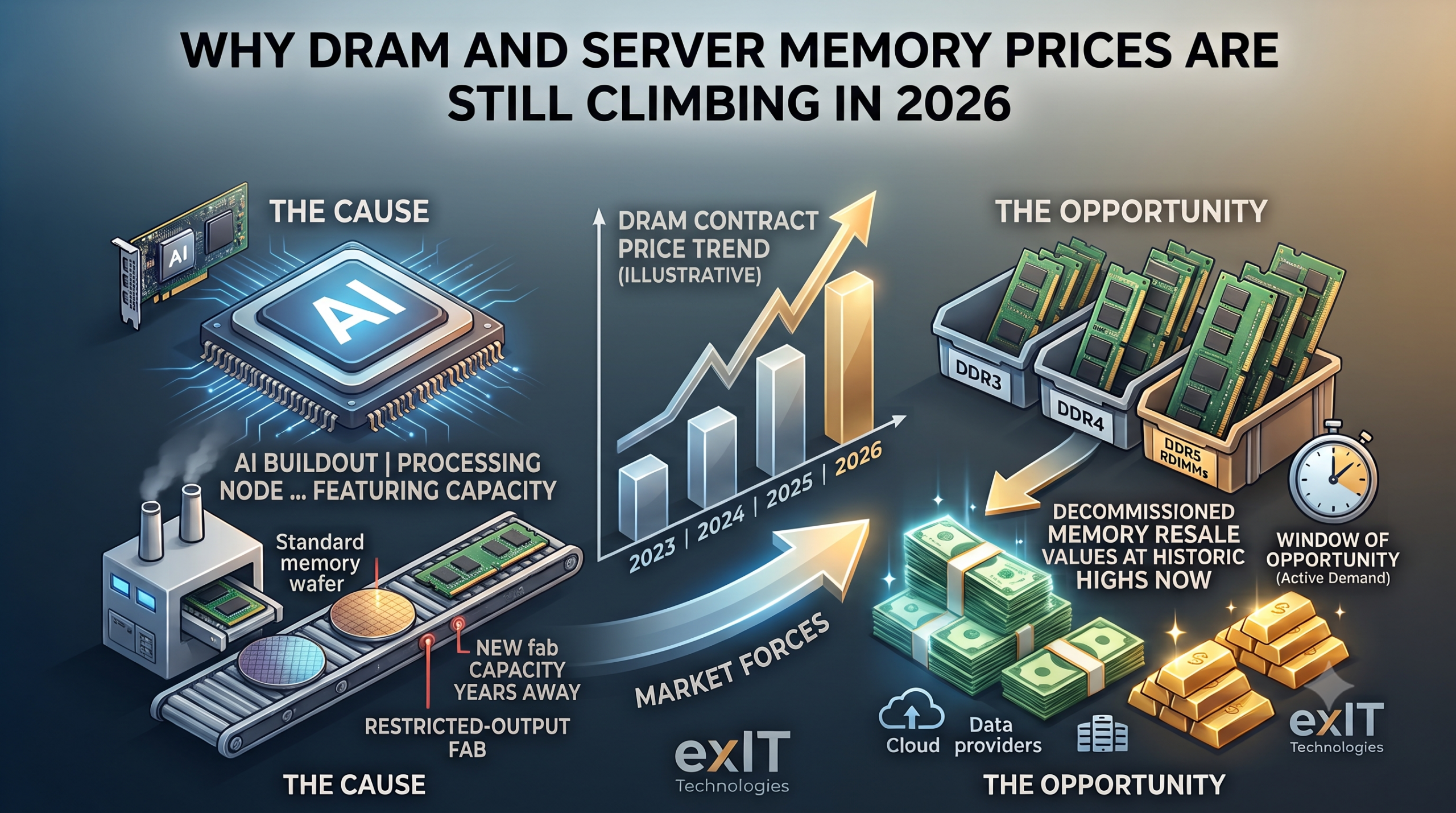
Il y a trois ans, un kit DDR5 de 32 Go coûtait $80. Aujourd’hui, le prix le plus bas est de $375, à condition qu’il soit disponible en stock.
Il ne s'agit pas simplement d'un pic passager. Le marché de la mémoire a connu une réévaluation durable. Selon les données de TrendForce pour juin 2026, les prix contractuels des DRAM conventionnelles au premier trimestre ont augmenté de 93 à 981 TP3T par rapport au trimestre précédent. Il s’agit de la plus forte hausse trimestrielle jamais enregistrée. Les enjeux sont considérables, et une mauvaise interprétation du marché peut entraîner des pertes financières colossales.
Voici ce que révèlent réellement les données sous-jacentes du marché de la mémoire, et ce que cela implique si vous devez prendre des décisions en matière d'achat ou de cession en ce moment même.
En bref : Tendances du marché de la mémoire pour 2026
- Selon TrendForce, les prix contractuels des mémoires DRAM ont augmenté de 93 à 981 TP3T d'un trimestre à l'autre au premier trimestre 2026, et les prévisions pour le deuxième trimestre tablent sur une nouvelle hausse de 58 à 631 TP3T d'un trimestre à l'autre. Ces évolutions s'expliquent par les investissements dans les infrastructures d'intelligence artificielle.
- Il faudra attendre fin 2027, voire 2028, au plus tôt, pour assister à de nouvelles hausses significatives de l'offre de DRAM.
- Selon TrendForce, les prix contractuels de la mémoire flash NAND devraient augmenter de 70 à 751 TP3T d'un trimestre à l'autre au deuxième trimestre 2026, dépassant pour la première fois de ce cycle le rythme de hausse de la DRAM.
- Si vous disposez de barrettes de mémoire serveur DDR3, DDR4 ou DDR5 mises hors service, sachez que leur valeur de revente sur le marché secondaire est exceptionnellement élevée. Cette opportunité ne durera pas indéfiniment.
- Karl Ackerman, analyste chez Raymond James, a signalé un pic potentiel des prix vers le milieu de l'année 2026, mais cela indique un ralentissement de la hausse des prix, et non un renversement de tendance. Les prix des contrats ne sont pas encore en baisse.
Quelles sont les causes de la hausse des prix de la mémoire ?
Le développement des systèmes d'inférence par IA mobilise des capacités de production qui étaient auparavant consacrées à la fabrication de mémoires pour serveurs et ordinateurs de bureau classiques.
À mesure que la demande en matière de formation des grands modèles de langage (LLM) et d’inférence IA augmente, les fournisseurs de services cloud réorientent leurs priorités de déploiement, délaissant les serveurs à usage général au profit de serveurs dédiés à l’IA. Il en résulte des besoins d’approvisionnement en mémoire qui vont au-delà des technologies HBM3e et LPDDR5X pour inclure des modules RDIMM couvrant une gamme plus large de capacités. La pénurie de DRAM, qui a débuté au sein des gammes de produits dédiées à l’IA, se répercute désormais sur la mémoire serveur classique sur laquelle fonctionne votre centre de données.
Les fournisseurs de services cloud aggravent cette situation par leur comportement d’achat. La disposition des CSP à accepter des hausses de prix a incité d’autres clients à leur emboîter le pas afin de s’assurer des quotas d’approvisionnement. Lorsque Microsoft, Google et AWS sont prêts à signer des contrats sur plusieurs trimestres à des prix élevés pour s’assurer un approvisionnement en HBM3e et en RDIMM haute capacité, tous les autres acheteurs se retrouvent relégués au second plan. Ils doivent en outre payer plus cher pour ce qui reste.
Les stocks des fournisseurs sont sur le point d'être épuisés, et la croissance des expéditions dépend désormais exclusivement de l'augmentation de la production de plaquettes. Le secteur fonctionne en production en temps réel. Toute perturbation de la production de plaquettes (problème de rendement, ralentissement d'une usine, problème logistique) se répercute sur les prix contractuels en l'espace de quelques semaines.
Du côté des mémoires NAND, la logique est la même. Les fournisseurs, soucieux de maximiser leurs profits, réorientent leur offre des SSD grand public vers les SSD destinés aux centres de données. Les acheteurs professionnels se disputent un marché limité, tandis que les particuliers se retrouvent avec une part du gâteau plus réduite que jamais.
Les chiffres : où en sont réellement les prix de la mémoire au troisième trimestre 2026 ?
Les prix contractuels sont ceux négociés chaque trimestre par les centres de données et les équipementiers. Les prix au comptant correspondent aux tarifs pratiqués sur le marché libre pour les commandes ponctuelles, et ce sont eux qui évoluent en premier. À l'heure actuelle, les deux types de prix suivent la même tendance.
| Système métrique | Situation à la mi-2026 | Source |
| Prix contractuels des DRAM classiques, 1er trimestre 2026 (variation trimestrielle) | +93-98% | TrendForce, juin 2026 |
| Prix contractuels des DRAM classiques : prévisions pour le deuxième trimestre 2026 par rapport au trimestre précédent | +58-63% | TrendForce, 31 mars 2026 |
| Prix contractuels de la mémoire flash NAND : prévisions pour le deuxième trimestre 2026 par rapport au trimestre précédent | +70-75% | TrendForce, 31 mars 2026 |
| Chiffre d'affaires total du secteur de la mémoire, 1er trimestre 2026 (variation trimestrielle) | +81%, vers $97B | TrendForce, juin 2026 |
| Kit DDR5 de 32 Go, octobre 2025 vs juin 2026 | ~$100-200 → $375 au minimum | Tom’s Hardware |
| Kit DDR4 de 32 Go, octobre 2025 vs janvier 2026 | ~$60-90 → ~$150-180 | Tom’s Hardware |
| Nouvelle offre (CXMT, YMTC) : volume significatif | Prévu pour fin 2027-2028 au plus tôt | TrendForce |
Les chiffres concernant les consommateurs confirment cette tendance. Un kit DDR5 de 32 Go qui se vendait entre $100 et $200 en octobre 2025 est désormais proposé à partir de $350, à condition qu’il soit encore en stock. La DDR4 n’est pas non plus une valeur sûre. Les mêmes kits DDR4 qui se vendaient entre $60 et $90 en octobre 2025 atteignaient déjà $150 à $180 en janvier 2026.
Comment interpréter les signaux du marché de la mémoire
Début juin, Karl Ackerman, analyste chez Raymond James, a déclenché une vague de ventes massives sur les valeurs du secteur de la mémoire en publiant une note indiquant que les prix de vente moyens des mémoires DRAM et NAND devraient atteindre leur pic à la mi-2026, avant de reculer pendant deux trimestres consécutifs à partir du début de l'année prochaine. Micron a perdu près de $95 milliard de capitalisation boursière en une seule journée. Les valeurs sud-coréennes et taïwanaises du secteur de la mémoire ont suivi le mouvement.
M. Ackerman prévoit un ralentissement du rythme de hausse des prix, et non un effondrement total. Il estime que l'impact d'un pic pourrait être moins grave que lors des cycles baissiers habituels, car les accords d'approvisionnement à long terme conclus entre les fabricants de puces et leurs clients pourraient contribuer à protéger le secteur d'une correction brutale.
Malgré ce léger recul, Micron a annoncé fin juin une hausse de son chiffre d'affaires de 346% par rapport à l'année précédente, et son action a atteint un niveau record. Qu'il s'agisse ou non d'un ajustement des prix, Micron a réussi à vendre ses produits à des prix de plus en plus élevés, et ses actions s'arrachent.
Les données réelles sur les contrats fournies par TrendForce révèlent une situation plus nuancée. Le rythme de hausse des prix de la DRAM ralentit, passant de 93 à 981 TP3T en glissement trimestriel au premier trimestre à une prévision de 58 à 631 TP3T au deuxième trimestre. Cela représente tout de même 58 à 631 TP3T en un seul trimestre. Les prix contractuels de la mémoire flash NAND devraient augmenter de 70 à 751 TP3T d'un trimestre à l'autre au deuxième trimestre, soit un rythme plus rapide que celui de la DRAM. C'est la première fois de ce cycle que la NAND devance la DRAM sur une base trimestrielle.
Dans sa mise à jour du 29 mai, TrendForce a indiqué que les prix au comptant des mémoires DRAM pour PC s'étaient stabilisés à un niveau proche de celui du mois de mai tout au long du mois de juin, à mesure que le cycle de négociation des contrats du deuxième trimestre touchait à sa fin. Les acheteurs au comptant continuent de se montrer réticents face aux prix actuels, mais cette réticence reflète une baisse de la demande. Certains acheteurs se retirent du marché car ils ne parviennent pas à absorber ces coûts.
Un ralentissement de la hausse des prix n'est pas synonyme de baisse des prix. Si vous attendez que les prix de 2024 reviennent, vous attendez une structure de marché qui n'existe plus.
Il ne faut pas s'attendre à de nouveaux approvisionnements avant 2027, voire plus tard
La mise en place de nouvelles capacités de production de semi-conducteurs prend des années, ce qui en fait un pari risqué pour n'importe quel fabricant.
Les fournisseurs devraient s'appuyer principalement sur des migrations de processus pour accroître leur production en bits en 2026, compte tenu des contraintes d'approvisionnement et du temps nécessaire à la construction de nouvelles salles blanches. Samsung et SK Hynix ont tous deux indiqué qu’ils ne poursuivraient pas d’expansion agressive de leurs usines. D’un point de vue économique, il est plus avantageux d’exploiter les lignes existantes à leur capacité maximale pour les produits présentant les marges les plus élevées. Ils produiront davantage de HBM et DRAM pour serveurs à haute capacité, et non pas de la DDR4 ou de la DDR5 d'entrée de gamme dont dépend votre cycle de renouvellement.
Les fabricants chinois de mémoires ChangXin Memory Technologies (CXMT) et Yangtze Memory Technologies (YMTC) augmentent leurs capacités de production, mais on ne s'attend pas à des volumes significatifs avant fin 2027 au plus tôt. Les restrictions imposées par la « Entity List » continuent de limiter l’accès de CXMT aux nœuds de fabrication les plus avancés, ce qui freine la rapidité avec laquelle l’entreprise peut se développer sur le marché de la DRAM pour serveurs, où la pénurie est la plus aiguë.
TrendForce et IDC concluent tous deux que les nouvelles capacités de production significatives de l'usine de Micron dans l'Idaho, du site de Samsung au Texas et de l'usine d'assemblage de SK Hynix dans l'Indiana n'atteindront pas les volumes escomptés. sortie avant la fin de l'année 2027 ou 2028.
Ce que cela signifie si vous disposez de mémoire excédentaire ou mise hors service
Tarification sur le marché secondaire La valeur de la mémoire vive récupérée sur les serveurs et les ordinateurs de bureau suit les prix de la mémoire neuve avec un certain décalage. Alors que les nouveaux modules RDIMM DDR4 se négocient à des prix qui auraient semblé impossibles il y a deux ans, les modules DDR4 récupérés que vous avez stockés dans vos bacs depuis votre dernière mise hors service valent plus que vous ne le pensez.
Les entreprises qui mettent hors service leurs serveurs ont désormais de bonnes raisons de donner la priorité à la récupération de la mémoire dans le cadre du processus de gestion du cycle de vie des équipements informatiques (ITAD). La mémoire DDR3 se vend toujours bien. La mémoire DDR4 ECC fait l'objet d'une forte demande. Les modules RDIMM DDR5 retirés des serveurs de 5e génération sont particulièrement prisés.
Si vous disposez de barrettes de mémoire vive (RAM) provenant de serveurs ou d'ordinateurs de bureau récemment renouvelés, c'est le moment idéal pour demander un devis plutôt que de les laisser dormir. Le marché offre actuellement une opportunité. La durée de cette opportunité dépendra de deux facteurs : d’une part, si l’hésitation des acheteurs au comptant se transforme en une tendance plus durable ; d’autre part, si les résultats financiers des fournisseurs de services cloud (CSP) du troisième trimestre confirment la persistance d’une pression à la hausse sur les achats liée à l’IA et stabilisent les prix à leur niveau actuel.
Les objets entreposés dans votre débarras n’attendent pas que le marché s’améliore, car ce marché est déjà là. Vous pouvez Tirez profit de votre mémoire inutilisée avant que la structure du marché ne change à nouveau.

 French
  English
  German
  Spanish
  Swedish
  Dutch
Dutch