

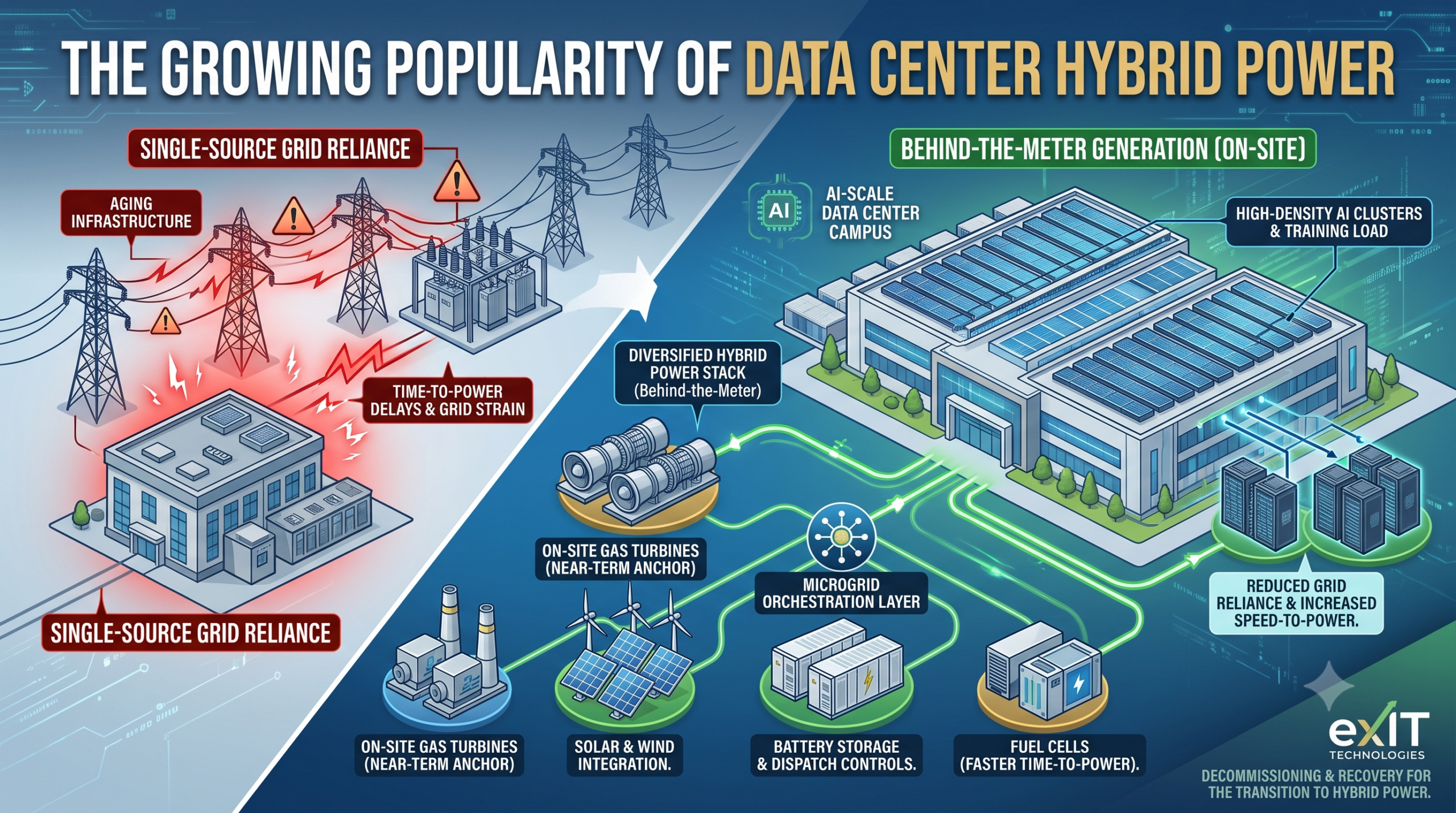
The U.S. grid was largely built for a world without AI-scale compute, and it’s showing.
Data centers are colliding with power infrastructure that was sized for slower, steadier growth, and the mismatch is starting to show up in delayed builds and sometimes even canceled projects.
Electricity demand in the U.S. is on pace to grow 15% to 20% over the next decade, driven largely by AI and data center expansion. Grid additions needed to absorb that growth take years longer to permit and build than a single compute cluster takes to deploy.
For data center operators, that timeline mismatch has turned power procurement into a strategic decision instead of an operational afterthought. Waiting on the grid alone is no longer a viable plan for anyone building at serious AI scale. More and more operators are turning to data center hybrid power models to decrease reliance on the grid.
Fast Facts: What You Need to Know About Hybrid Power Data Centers
- A single-source model, whether that’s grid-only or generator-only, can’t meet the reliability and speed-to-power requirements of an AI campus by itself.
- Hybrid stacks blending on-site gas, fuel cells, renewables, and microgrids are becoming the default architecture for new builds
- The Electric Power Research Institute projects data centers could consume up to 9% of U.S. electricity generation by 2030, up from 4% in 2023.
- Standing up a hybrid power system means retiring legacy single-source equipment, diesel gensets, UPS strings, and battery racks, on a refresh cycle that’s compressing right alongside GPU turnover.
Why Single-Source Power Models Are Coming Up Short
A grid-only model assumes the utility can deliver capacity on your schedule. For most AI-scale builds right now, it can’t. New demand for power (driven in large part by AI-focused data centers) is outpacing the pace of grid capacity expansion, and aging infrastructure is being pushed to its limits. Demand spikes from heat waves and grid disruption from extreme weather events push the limits even further.
A generator-only or fully off-grid model solves the speed problem but introduces a different one: fuel logistics, emissions permitting, and maintenance cycles that data center operators were never built to run as a core competency.
Neither extreme holds up under AI-scale load.
A campus being constructed to lean entirely on the grid risks multiyear delays. A campus that leans entirely on private generation takes on operational and regulatory complexity most facilities teams don’t have the headcount for.
Hybrid architectures split the difference by design. Grid power handles steady-state baseload where it’s available. On-site generation, storage, and renewables absorb the gap.
Why The Demand For Hybrid Power In Data Centers Is Increasing
AI training and inference clusters pull power density that most regional grids weren’t built to deliver.
A March 2026 Bloom Energy survey describes this as a “time-to-power mismatch” between what developers need and what utilities can deliver. Grid interconnection queues in several major markets are stretched thin enough that utility-scale projects are being delayed or canceled outright.
Leading hyperscalers signed a nonbinding Ratepayer Protection Pledge at the White House in March 2026, committing to shoulder more of the generation cost tied to their own expanding footprint.
All these factors point to less reliance on the grid, and creative approaches to ensure data centers avoid outages and have a constant stream of reliable power.
The Strain AI Data Center Demand Places on Power Grids
The U.S. Department of Energy expects total electricity demand to grow 15% to 20% over the next decade, a swing driven largely by AI, data center expansion, and new domestic manufacturing.
CBRE’s North American data center trend report found that construction activity across the country’s primary hubs (including dense markets like Northern Virginia and Dallas-Fort Worth) slowed for the first time since 2020. Power procurement failed to keep pace with surging demand, pushing total under-construction capacity down. Supply chains for the hardware that would solve this are backed up too.
Wood Mackenzie’s supply chain recherche found that by 2025, the typical wait for a gas turbine order had stretched to nearly five years (up from roughly two years in 2021). Some industry estimates put the current backlog closer to six years, driven largely by surging demand from data centers.
That’s more than four and a half years between order and delivery for a piece of equipment that used to ship in a fraction of that time.
4 Major Hybrid Power Models For Data Centers
No single technology is winning this fight. Steven Shparber, co-chair of Mintz’s Digital Infrastructure Practice, expects a mix of technologies to dominate as supply chains evolve and operators match their power stack to site-specific constraints.
On-site power, or behind-the-meter generation, sits on the customer’s side of the utility meter. It’s the umbrella category for everything below, and it’s what lets an operator start pulling load before a permanent grid interconnect exists.
- Hybrid renewables: Solar and wind paired with long-duration batteries are improving as operators gain experience managing intermittency. Newer battery chemistries and dispatch controls are widening what counts as a viable steady-load design.
- Fuel cells: These are moving from backup duty into behind-the-meter baseload for AI campuses. Hydrogen-ready systems offer a 9-12-month speed-to-power advantage over turbines stuck in multiyear order backlogs. The cell approach risks performance fading over the equipment’s service life.
- Microgrids: The microgrids function as the orchestration layer that ties these sources together. A well-engineered microgrid can island safely during a grid event, prevent unsafe backfeeding, and export power to the utility during peak demand, turning the data center into an active grid partner instead of a passive customer.
- Gas generators and turbines: These are the most common near-term anchors for reliable power. They deliver steady output in a compact footprint, and some units can shift from natural gas to renewables as that supply matures. FTI Consulting expects gas to anchor new AI data center power supply well into the 2030s, with carbon capture treated as the path to keeping that generation viable under tightening emissions rules.
Layer these options with battery storage as the connective tissue and you get a system that can absorb a generator outage, ride through a grid disturbance, and still hold voltage steady for a GPU power spikes.
Hybrid Power Data Center Bring More Equipment Turnover
Data center hybrid power buildouts don’t stop at the switchgear. Higher-density racks built to support GPU-heavy AI workloads drive a parallel refresh cycle across servers, storage, and networking gear. This often operates on the same timeline as the power upgrade itself.
Once it’s retired, the data center hardware shouldn’t sit idle. It needs documented, audit-ready handling: chain of custody, certified data destruction, and value recovery on anything still worth reselling.
If your hybrid power rollout is accelerating your GPU or server refresh, exIT Technologies handles that side of the transition. Our services de déclassement de centres de données cover the planning, destruction, and reporting your compliance team will ask for before the next rack goes live.

 French
  English
  German
  Spanish
  Swedish
  Dutch
Dutch