

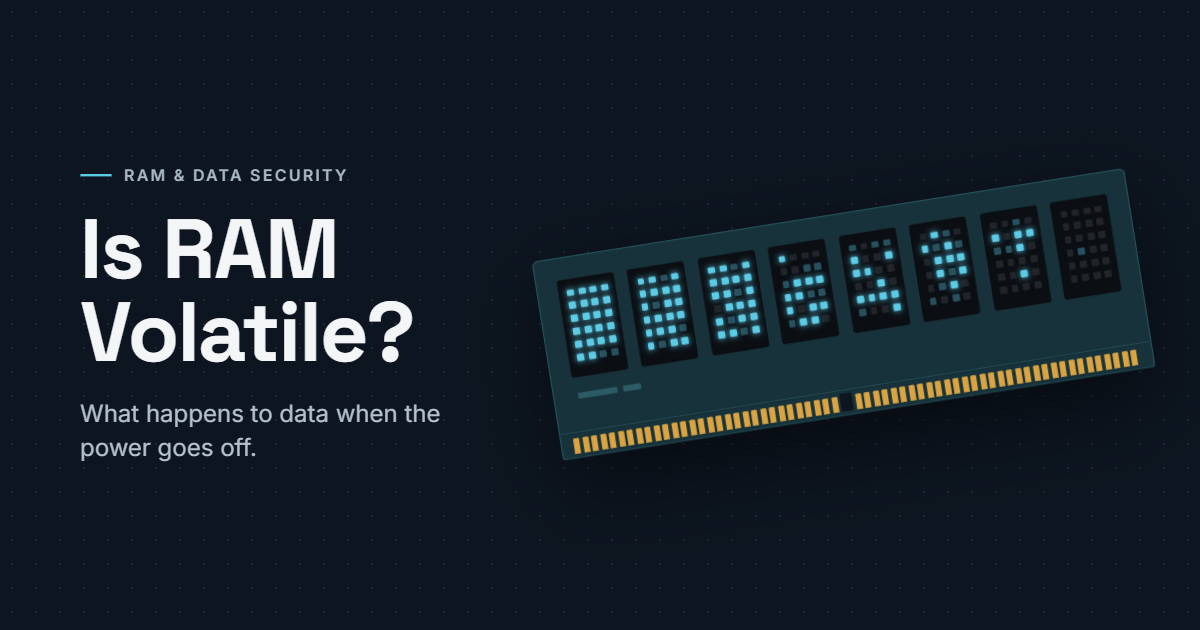
Yes, RAM (Random Access Memory) is volatile, meaning it requires power to retain data. When power is removed, conventional RAM loses its stored data as the electrical states representing that data decay. Unlike SSDs and hard drives, standard RAM is not designed to preserve information after shutdown.
However, data doesn’t always disappear instantly. Some memory technologies are also designed to retain data without power, creating important distinctions for businesses decommissioning or reselling IT equipment.
This article explains how RAM volatility affects data security, whether information can be recovered after shutdown, and when memory needs to be sanitized before resale.
Key Takeaways
- Conventional RAM is volatile and loses its data after power is removed.
- Data can remain recoverable briefly after shutdown through a phenomenon called data remanence.
- Persistent memory, including Intel Optane PMem and NVDIMMs, requires different security procedures.
- Conventional DRAM usually does not require storage-style wiping before resale, but organizations should follow an approved disposition procedure.
What Is Volatile RAM?
Volatile memory requires continuous electrical power to retain data. RAM acts as a computer’s short-term working memory, temporarily storing the applications, instructions, and information that processors need to access quickly.
Most desktop, laptop, and server RAM uses Dynamic Random Access Memory (DRAM). DRAM stores data as electrical charges within microscopic capacitors that must be continuously refreshed. When power is removed, those charges dissipate, causing the stored data to disappear.
Static Random Access Memory (SRAM), commonly used in processor caches, is also volatile. It uses transistor-based circuits rather than DRAM’s capacitor-based design.
Computers use volatile RAM because it provides fast access to working data, while non-volatile storage devices preserve information between sessions.
Volatile vs. Non-Volatile Memory
The main difference is whether data survives after electrical power is removed.
| Característica | Conventional DRAM | Persistent Memory | SSDs and HDDs |
| Retains data without power | No, apart from temporary remanence | Yes, depending on configuration | Sí |
| Primary purpose | Active processing | Persistent memory workloads | Long-term storage |
| Examples | DDR4, DDR5, ECC RDIMMs | Optane PMem, NVDIMM-N | NVMe SSDs, SATA SSDs, HDDs |
| Security consideration | Short-term data remanence | Data retained after shutdown | Data retained after shutdown |
Standard DDR4 and DDR5 modules are volatile, including conventional enterprise registered DIMMs (RDIMMs) and load-reduced DIMMs (LRDIMMs). Their performance and architecture differ, but they all require power to maintain their working data.
Can Data Be Recovered From RAM After Shutdown?
Yes, under certain conditions, data can be recovered from conventional RAM shortly after power loss. Although DRAM is volatile, its electrical charges do not disappear instantaneously.
This temporary persistence is called data remanence. The amount of time information remains recoverable depends on the memory technology, temperature, and conditions surrounding shutdown.
What Is a Cold Boot Attack?
A cold boot attack attempts to recover residual information from RAM before its stored data has completely decayed.
In the landmark 2008 study Lest We Remember: Cold Boot Attacks on Encryption Keys, researchers demonstrated that information could remain recoverable after a system lost power.
At normal operating temperatures, complete data decay occurred in approximately 2.5 to 35 seconds across the tested systems. Cooling memory dramatically extended retention. At approximately -50°C, one tested module showed a bit-error rate of just 0.000036% after ten minutes without power.
The researchers also demonstrated that residual memory contents could be used to reconstruct encryption keys. These results illustrate why immediate physical access to recently powered-down equipment can create a security risk. However, the experiments involved older memory technologies, so their recovery times should not be applied universally to modern hardware.
Can Cold Boot Attacks Affect DDR4 or DDR5 RAM?
Newer memory technologies introduced additional protections, including memory scrambling, but these measures have not eliminated every cold boot vulnerability.
A 2017 study presented at IEEE HPCA demonstrated recovery of AES encryption keys from DDR4 memory connected to an Intel Skylake processor. The researchers showed that memory scrambling alone did not prevent the demonstrated attack.
Public research establishing comparable cold boot recovery windows for DDR5 is more limited. It would therefore be inaccurate to assume DDR5 behaves identically to the DDR4 systems studied.
While operating, RAM can contain passwords, encryption keys, authentication credentials, customer records, and other sensitive data. For organizations retiring equipment, the practical priority is maintaining physical control during shutdown and following documented security procedures.
Is All RAM Volatile?
No. While conventional DDR4 and DDR5 DRAM is volatile, certain enterprise memory technologies are designed to preserve data after power loss. These modules are especially important to identify when decommissioning older servers or purchasing used enterprise memory.
Intel Optane Persistent Memory
Intel has discontinued its Optane Persistent Memory product line, but modules remain in older enterprise servers and secondary-market inventories. Optane PMem uses non-volatile media and supports several operating configurations:
- Memory Mode: Provides volatile system-memory behavior, with conventional DRAM acting as a cache and encryption mechanisms protecting the underlying media.
- App Direct Mode: Allows applications to access persistent data that survives shutdown.
- Mixed Mode: Divides available capacity between volatile and persistent uses.
Because Optane uses non-volatile media, organizations should verify the module configuration and use an appropriate manufacturer-supported sanitization procedure before resale.
Intel persistent-memory management documentation explains that changing memory allocation configurations does not explicitly erase existing user data. Management utilities and supported platforms provide security operations, including secure erase.
NVDIMMs and Battery-Backed Memory
Non-Volatile Dual In-line Memory Modules (NVDIMMs) preserve data during power interruptions. For example, NVDIMM-N combines conventional DRAM with non-volatile storage. When power is lost, a backup power source allows the module to transfer its contents into persistent storage.
Battery-backed and capacitor-backed memory technologies serve similar data-protection purposes. Unlike conventional DRAM, these technologies require separate sanitization evaluation because their contents can survive shutdown.
How to Identify Persistent Memory
1. Check manufacturer part numbers to identify the exact memory technology.
2. Review the server hardware inventory for persistent-memory configurations.
3. Look for designations such as Optane PMem, NVDIMM-N, or persistent memory.
4. Consult manufacturer documentation, including Statements of Volatility.
A Statement of Volatility (SoV) identifies which components retain data without power and may describe supported clearing procedures. These documents are often published for complete systems or boards rather than individual DIMMs.
If the memory technology cannot be confirmed, the module should be treated as potentially data-bearing until its retention characteristics are established.
What about the small flash chip on conventional RAM? Many DIMMs contain Serial Presence Detect (SPD) memory, which stores module specifications such as capacity, speed, and manufacturer information. SPD does not store the computer normal application data.
Does RAM Need to Be Wiped Before Selling It?
Conventional DRAM usually does not require the same storage-style wiping procedures as an SSD or hard drive before resale. Removing power causes its stored data to decay, but organizations should still verify the memory technology and follow an approved security procedure.
Persistent memory is different. Optane PMem, NVDIMMs, and other non-volatile technologies require appropriate sanitization or destruction before they leave organizational control.
What Does NIST Recommend for RAM Sanitization?
NIST Special Publication 800-88 Revision 2, finalized in September 2025, provides guidance for media sanitization. The current revision distinguishes volatile from non-volatile media and directs organizations toward risk-based sanitization procedures, applicable technical standards, and manufacturer documentation.
It also recommends consulting manufacturers Statements of Volatility to identify components that retain data.
What about the five-minute RAM power-off rule? The previous standard, NIST SP 800-88 Revision 1, specified that conventional DRAM should remain without power for at least five minutes. Its instructions included powering off the device, disconnecting applicable power sources and batteries, or removing the memory module.
That was a sanitization instruction, not a scientific guarantee that data could never be recovered after five minutes under unusual conditions.
Is RAM Safe to Resell After Being Unpowered During Shipping?
Conventional RAM removed from servers, packaged, and shipped to a buyer will normally remain without power for hours or days.
Under ordinary transportation and storage conditions, this is substantially longer than the recovery windows documented in the original room-temperature cold boot experiments. As a practical security assessment, recovery of previous working-memory contents from conventional DRAM after that period is highly unlikely.
This conclusion does not apply to persistent memory and should not replace controlled shutdown procedures or chain-of-custody requirements.
How Should Businesses Handle RAM Before Resale?
1. Identify the memory technology. Confirm whether modules are conventional DRAM or persistent memory using part numbers and manufacturer documentation.
2. Follow an approved shutdown procedure. Disconnect power, account for backup power sources, and apply the organization required unpowered interval.
3. Maintain chain of custody. Record asset identifiers, responsible personnel, transfer dates, locations, recipients, and relevant disposition documentation.
4. Evaluate other data-bearing components. If retiring complete servers, separately address storage drives, persistent memory, RAID cache, management controllers, and other components that retain data.
Organizations with regulatory or contractual security obligations may require additional documentation, sanitization, or destruction procedures.
Where can I sell my RAM?
For organizations selling conventional enterprise memory, exIT Technologies offers a used RAM buyback service.
Businesses retiring complete servers or data centers can use our broader IT asset disposition services to address data security, equipment handling, and disposition documentation.
Frequently Asked Questions About RAM Volatility
Is RAM volatile or non-volatile?
Conventional RAM is volatile because it requires power to retain data. Specialized persistent-memory technologies are exceptions that require different handling.
Is DDR4 RAM volatile?
Yes. Standard DDR4 DRAM is volatile and loses its stored data after power is removed.
Is DDR5 RAM volatile?
Yes. Standard DDR5 DRAM is volatile. Its performance improvements do not change the requirement for electrical power to retain data.
Can someone recover data from used RAM?
Cold boot attacks have demonstrated that some DRAM data can be recovered shortly after power loss. Recovery depends on the hardware, temperature, elapsed time, and security protections.
Does RAM need to be wiped before resale?
Conventional DRAM usually does not require storage-style wiping, but it should be handled under an approved disposition procedure. Persistent memory requires separate sanitization evaluation.
How long does RAM retain data after shutdown?
The original research documented complete decay in approximately 2.5 to 35 seconds on tested systems at normal operating temperatures, with much longer retention under extreme cooling. These figures do not establish a universal timeframe for modern memory.
Can RAM contain passwords or encryption keys?
Yes. RAM can hold credentials, cryptographic keys, and other sensitive data while applications and operating systems are running.

 Spanish
 English
 German
 French
 Swedish
 Dutch