

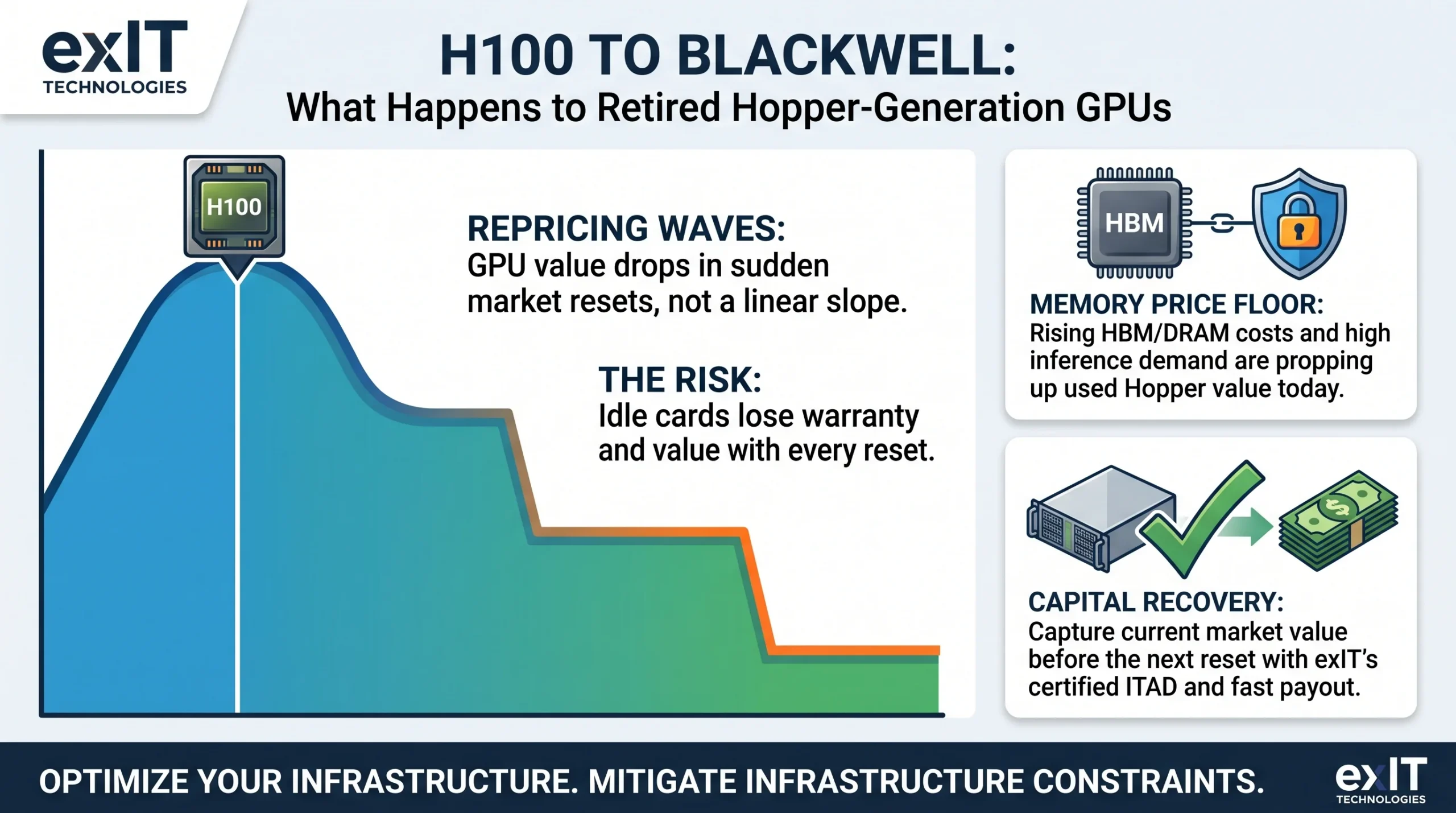
If you bought H100s during the 2023 to 2024 buildout, you have probably been working from a straight-line assumption. Blackwell arrived, Hopper is last generation, and value drains a little every month.
The H100 to Blackwell transition turns out to be a worse predictor of your resale number than the recent memory shortage. Your asset management plan should reflect broader market factors, not just the age of your GPUs.
Fast Facts: What You Need To Know About Generational GPU Value
- A new H100 80GB card still lists around $31,000 as of August 2026, and refurbished cards at roughly $18,000 to $22,000.
- Hopper generation GPU depreciation comes in waves. Retained value runs near 61% at the two-year mark and 45 to 55% by year three.
- A 15% increase on new Blackwell and Rubin systems makes used Hopper a good value option.
The 2023 to 2024 H100 Buildout, and Why It Matters Now
The H100 buildout was compressed into an unusually narrow window. Allocation lists, six-month lead times, and SXM5 cards changing hands near $40,000 at the peak meant that anyone who needed Hopper capacity bought it in the same eighteen-month stretch. This often happened at whatever price could clear the order quickly.
The same buildout now reaches the same disposition question at close to the same time. Your resale window is shared with everyone else who was on those allocation lists. Volume of that kind moves a market. To recover the most value, you need to be early in that wave.
What Actually Happens to Retired H100 GPUs
Very little Hopper hardware is being scrapped. Functional H100s move down three paths:
- Continued in-house service on inference workloads.
H100s remain economically sensible for production serving, and enterprise GPUs have a longer operational tail than the marketing cycle suggests. Azure ran V100 instances for roughly seven and a half years, and CoreWeave reported rebooking H100 capacity at about 95% of its original contract pricing. - Direct sale into the secondary market.
The secondary market here is robust. For example, Compute Exchange launched a dedicated secondary GPU marketplace in July 2026 and reported that buyer demand is concentrated on established H100 and A100 systems rather than on Blackwell parts. Requests came in ranging up to tens of thousands of GPUs. - Refurbishment and consignment. In this scenario, cards are tested, reconditioned, and resold with limited warranty coverage. Refurbished units consistently price above raw used inventory, which is why documentation and test data matter more than most sellers expect.
Hopper Depreciation Moves In Waves
Analysts tracking H100 market value describe the pattern as repricing rather than depreciation. Value holds for months, then resets sharply when something external changes. Silicon Data puts the planning implication plainly: the risk is a sudden reset.
The resets have identifiable causes. AWS 15 H100 on-demand pricing by roughly 44% in June 2025 and the rest of the market followed, which repriced everyone’s resale expectations. Architectural launches do the same thing on a longer cycle.
The retained-value numbers make more sense through that lens. Mid-case retention at 36 months lands around 50-60% of original card price, while one liquidation analysis estimates a two-year-old H100 near 61%. The same analysis describes a drop into the 45-55% range by the three-year mark. Measured against the 2023 panic peak instead of a normal purchase price, retention looks closer to 20-40%.
The Memory Shortage Is Holding Up Your Floor
The most useful thing happening to H100 resale value in 2026 has nothing to do with GPUs. Samsung, SK hynix, and Micron have redirected wafer capacity toward high-bandwidth memory for AI accelerators, HBM and DRAM capacity for 2026 sold out well before the year started, and conventional DRAM contract prices rose 80 to 95% quarter over quarter into early 2026.
That cost is now reaching the top of the stack. Memory has climbed from a modest share of a rack’s bill of materials to roughly 25% on high-end systems, which is what produced the 15% increase NVIDIA flagged to its largest customers this month. New Blackwell and Rubin capacity is getting more expensive.
The catch is that this floor of the hardware’s value is not directly correlated to the unit itself.
What This Means If You Are Still Holding H100s
Start by sorting the fleet honestly into three buckets:
- Cards carrying production workloads
- Cards that have drifted into secondary or development roles
- Cards that are genuinely idle
Most organizations retiring H100 GPUs in a data center discover the third bucket is larger than the capacity plan claims.
Idle inventory is where the real exposure sits. Those cards accrue no return while remaining fully exposed to the next reset, and every month they sit is a month of warranty coverage burning off. Units with twelve or more months of transferable warranty trade meaningfully higher than units without. The warranty window is a harder deadline than any depreciation curve.
Cards still earning their power draw are a different calculation. AI inference demand is what’s holding H100 prices where they are, so hardware that is actively serving traffic is not the hardware to rush.
Your Inventory Won’t Be Valuable Forever
There is no scheduled cliff on the calendar for Hopper. What there is instead is a floor propped up by memory economics and a market that reprices in jumps rather than slopes. Owners who play the waiting game are gambling on a supply chain they have no visibility into.
If a block of your H100s is already idle, the useful next step is a current number rather than another depreciation estimate. exIT Technologies buys retired Hopper-generation hardware and prices fleets against what the secondary market is paying this month, including warranty status and test documentation in the valuation. You can get a valuation on used NVIDIA GPUs or send over an asset list and get a quote back.

 German
  English
  Spanish
  French
  Swedish
  Dutch
Dutch