

Data centers now sit at the center of the global economy, and the equipment that fills them keeps the operations going.
How does it get there?
Getting Server, racks, cooling units, and power systems to the right place at the right time, without damaging them or disrupting live operations, is the job of data center logistics. As demand for compute capacity keeps climbing, the logistics behind it is becoming one of the most specialized corners of the supply chain.
Fast Facts: What You Need To Know About Data Center Logistics
- $3 trillion in infrastructure investment is expected globally through 2030, with roughly 100 GW of new data center capacity coming online in that window, according to JLL.
- More than half of operators who had a significant outage in the past year said it cost over $100,000; 1 in 5 reported costs exceeding $1 million.
- Power issues remain the leading cause of impactful outages, accounting for about 45% of incidents in 2025 gemäß to Uptime Institute. The most frequent offender was UPS failures.
What Is Data Center Logistics?
Data center logistics is the coordinated planning, transportation, handling, and tracking of the physical equipment that keeps a data center running. It ranges from the moment it’s sourced from a manufacturer to the moment it’s retired. That includes servers, storage arrays, Netzwerkausrüstung, racks, uninterruptible power supplies (UPS), generators, and cooling infrastructure.
Unlike general freight, this equipment is high-value, fragile, and often mission-critical the moment it’s installed. A shipment that shows up a day late can push back an entire commissioning schedule. A rack that’s mishandled in transit can fail once it’s live. That combination of value, fragility, and time pressure is what separates data center logistics from standard warehousing and freight.
What Are The Key Components of Data Center Logistics?
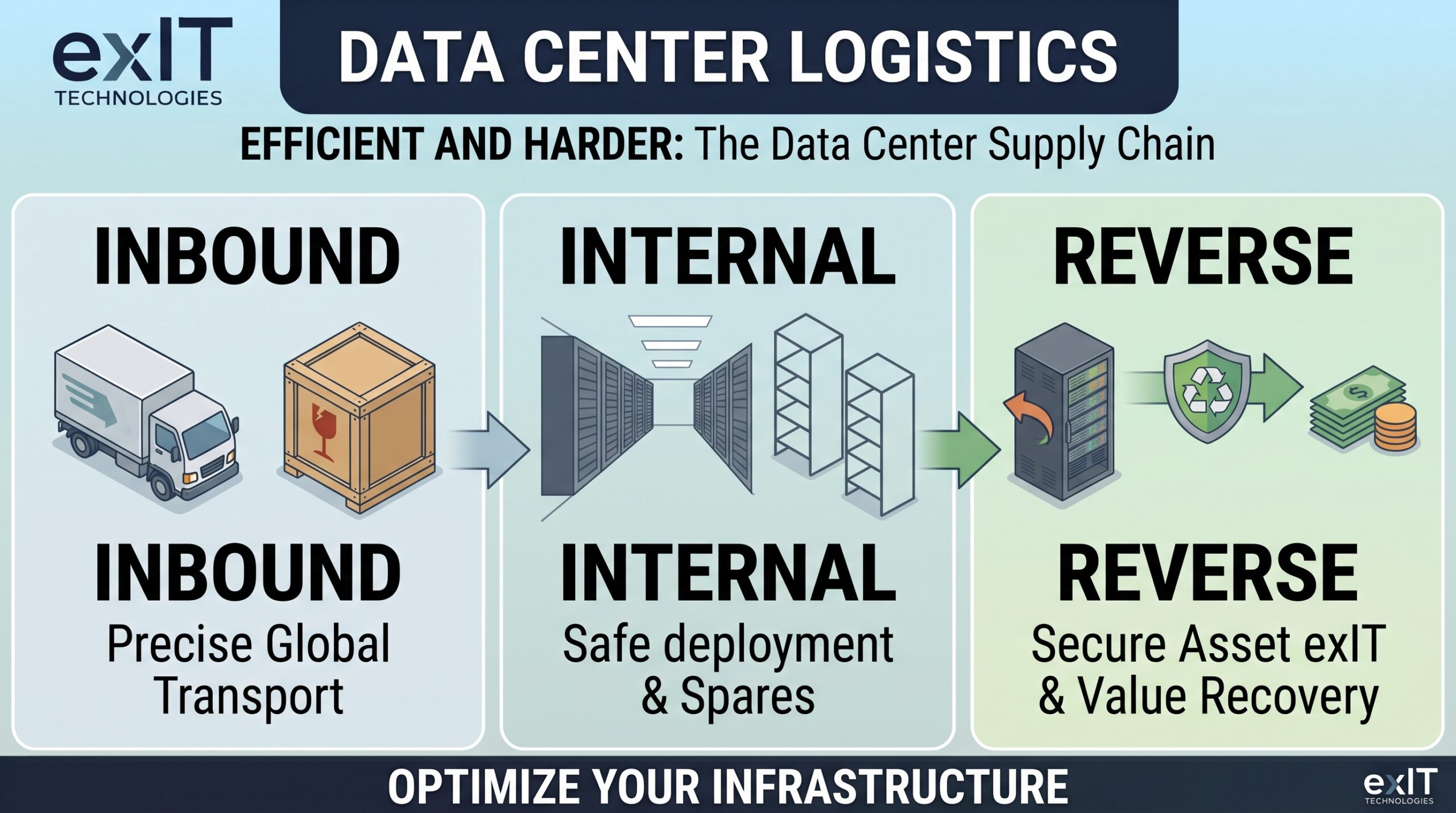
Most data center logistics programs are built around three connected flows:
- Inbound logistics: Sourcing, scheduling, and receiving equipment from manufacturers and vendors. Then, staging it on-site in the sequence installation teams need it.
- Internal logistics: Moving equipment within the facility, from staging areas to the data hall, racking and stacking, and placing assets into live environments. All this needs to be done without disrupting operations already running nearby.
- Outbound and reverse logistics: Removing decommissioned or end-of-life equipment securely, tracking it through the process, and routing it toward reuse, resale, or disposal.
One smaller component that supports all three is inventory and spare parts management. Unplanned downtime is quite costly, so operators typically keep a buffer of critical components on hand: power supplies, drives, network cards. Easy access to common hardware needs can ensure a failure doesn’t turn into an extended outage while a replacement part is in transit.
What Is the Role of Data Center Logistics?
The core role of data center logistics is protecting uptime. Every stage of a data center’s lifecycle (new builds, capacity expansions, hardware refreshes, and routine maintenance) depends on equipment arriving in usable condition, on schedule, and in the correct sequence. Logistics teams act as the coordination layer between equipment vendors, freight carriers, and on-site installation crews. They align transportation and dock access with the exact moments construction and IT teams are ready to deploy.
This role has grown more visible as outages have gotten more expensive. Uptime Institute’s 2025 outage analysis found that more than half of operators who experienced a significant, serious, or severe outage in the past year said it cost over $100,000, and one in five reported costs exceeding $1 million. A delayed or damaged delivery can trigger that kind of loss, so logistics can’t just be a back-office function. Ideally, logistics should be part of the operational risk plan.
What Are the Biggest Challenges of Data Center Logistics?
Zero tolerance for delay. Installations are often scheduled around narrow windows tied to power availability, contractor access, and construction milestones. A missed delivery can force rescheduling across multiple teams and vendors.
Sensitive, high-value equipment. Servers and power systems are vulnerable to shock, vibration, temperature swings, and static discharge. They can’t be shipped like raw materials or rugged goods. Protecting them in transit requires specialized packaging, handling protocols, and trained personnel.
Security and chain of custody. Because this equipment often carries both financial value and stored data, every handoff needs to be documented and controlled, from pickup through final placement and eventual decommissioning.
Global, interdependent supply chains. Components are frequently manufactured in one region, integrated in another, and deployed somewhere else entirely. That comes with the potential for customs delays, capacity constraints, or geopolitical disruption in one location that stalls a project on the other side of the world.
Scale. On-premises facilities still host a substantial share of enterprise IT (Uptime Institute puts it at 45% of workloads) while hyperscale campuses move thousands of assets on compressed timelines. Standardized processes and real-time visibility become harder to maintain as volume grows.
Building a More Resilient Approach To Data Center Logistics
Operators managing these challenges tend to invest in a few common areas:
- Forward visibility through digital tracking and control towers
- Pre-positioned spare parts near critical sites
- Clear service-level agreements across every vendor and carrier involved
- Contingency plans for weather, customs, or supply disruptions.
None of these eliminate risk entirely, but together they shrink the window in which a single delay or mishandled shipment can turn into a costly outage.
Where ITAD Fits In
The outbound side of data center logistics deserves particular attention.
When hardware reaches end of life, it still needs to move securely, and the data stored on it needs to be handled just as carefully as the equipment itself. That’s where IT asset disposition (ITAD) comes in. It’s the certified processes for wiping data, Stilllegungsausrüstung, and routing retired assets toward reuse, resale, or responsible recycling.
If your organization is planning a hardware refresh or facility decommission, pairing your logistics plan with a vetted ITAD partner is worth exploring before that equipment ever leaves the rack.

 German
  English
  Spanish
  French
  Swedish
  Dutch
Dutch