

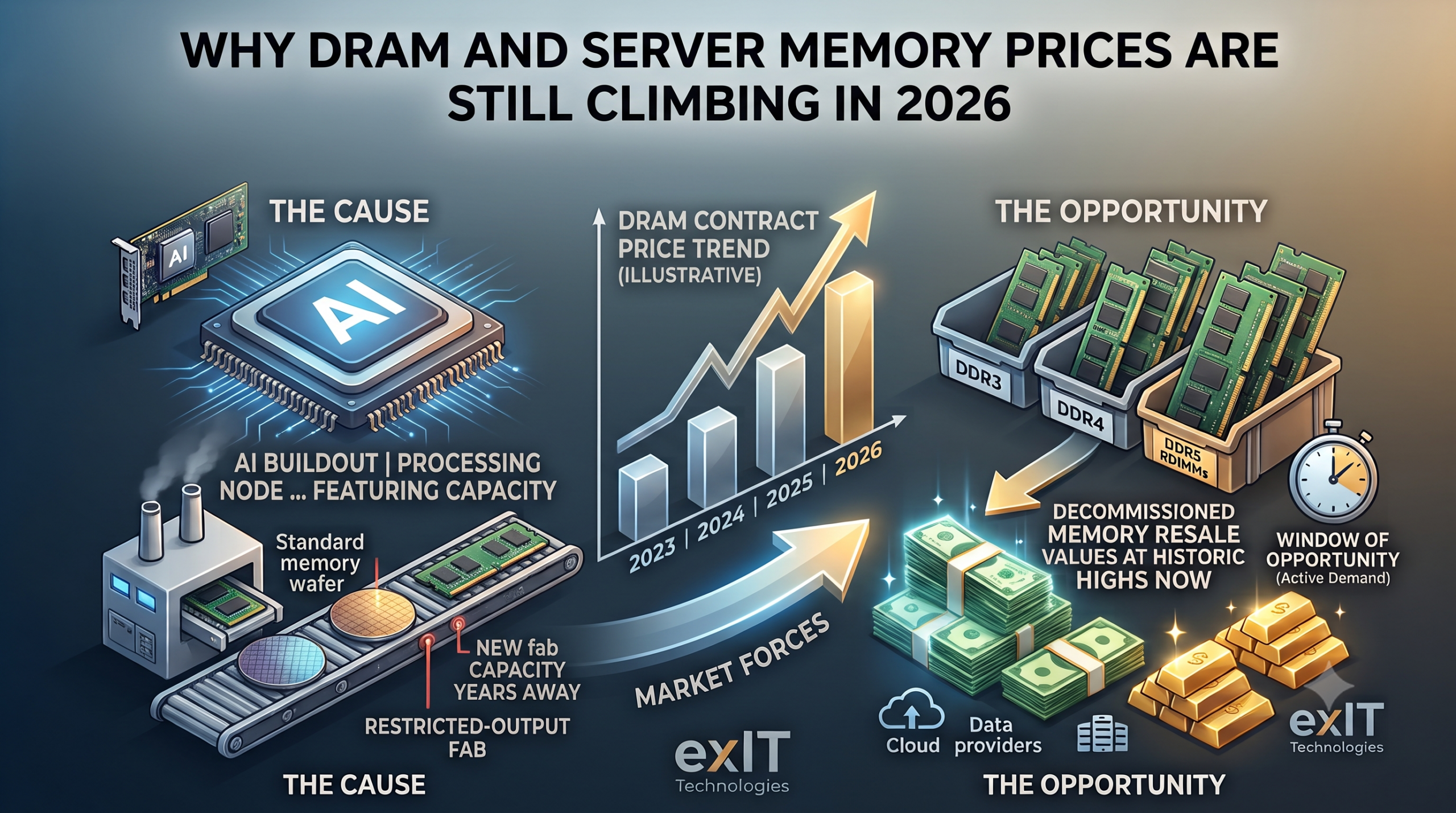
In early July, TrendForce told memory buyers to expect a calmer third quarter, forecasting conventional DRAM contract prices up 13-18% after a 58-63% jump in Q2. Within a week, Taiwanese module maker ADATA said its suppliers were notifying customers of increases closer to 20-30%.
Server memory prices are still climbing in Q4 2026. Forecasts show the pace slowing, though actual vendor quotes have slowed far less than the forecasts suggested. A new supply problem has also surfaced: the HBM4 memory going into Nvidia’s next AI platform is pulling wafers away from the DDR4 and DDR5 your servers run on.
If you’re sitting on pulled RAM from your last refresh, that combination is why it deserves a second look this quarter rather than next year.
Fast Facts: What You Need to Know About DRAM Prices in Q4 2026
- Samsung and SK Hynix’s finished memory inventory fell below 10 days of supply, according to estimates.
- The mainstream DDR4 spot chip (1Gx8, 3200MT/s) averaged $42.50 the week of August 10, up from $32.30 in mid-May, per TrendForce. A 32% increase in about three months.
- Total DRAM industry revenue rose 59.5% QoQ in Q2 2026 to nearly $154.73 billion, while bit shipments grew only modestly. That’s from higher pricing, not volume.
- TrendForce’s September 30 forecast calls for another 10-15% rise in conventional DRAM contract prices in Q4 2026.
- Prices for pulled DDR3, DDR4, and DDR5 on the secondary market follow new-memory prices with a lag, which keeps resale values unusually strong while contract prices rise.
What’s Causing Memory Prices To Increase?
De uitbreiding van AI-inferentie neemt productiecapaciteit in beslag die voorheen werd gebruikt voor de productie van conventioneel server- en desktopgeheugen.
As demand for LLM training and AI inference grows, cloud service providers are shifting deployment priorities from general-purpose servers toward AI-specific servers. Their memory procurement now reaches beyond HBM and LPDDR5X to include RDIMMs across a broader range of capacities. The DRAM supply crunch that started in AI-specific product lines has spread into the conventional server memory your data center actually runs on.
Cloud providers are making this worse through their purchasing behavior. When Microsoft, Google, and AWS sign multi-quarter agreements at elevated prices to lock in HBM and high-capacity RDIMM supply, every other buyer gets pushed down the queue and pays more for what’s left.
Supplier inventories now sit at historic lows, according to TrendForce’s September 7 report, and most additional supply is going to server use. The industry is running on real-time production. Any interruption to wafer output (a yield issue, a fab slowdown, a logistics problem) shows up in contract prices within weeks.
NAND follows the same logic. Suppliers chasing margin are shifting supply from client SSDs to data center SSDs, so enterprise buyers compete for a limited pool and consumer buyers get a smaller share than ever.
Why The Conventional DRAM Market Is Vanishing: The HBM4 Memory Chip Shortage
Samsung and SK Hynix are now holding less than 10 days of finished memory inventory, according to a KB Securities estimate reported by DigiTimes on September 7, 2026. Neither company discloses inventory at that level, so treat it as an analyst estimate. It lines up with TrendForce’s separate finding that supplier inventories sit at historic lows.
The cause is wafer allocation. HBM4, the stacked high-bandwidth memory that sits beside Nvidia’s Vera Rubin GPUs, is built from the same DRAM wafers that would otherwise become DDR4 and DDR5. KB Securities estimates HBM4 takes roughly three times the wafer capacity of conventional DRAM to produce the same number of bits.
Samsung now runs about 150,000 DRAM wafers a month for HBM, with roughly 75,000 of those going to HBM4, according to Chosun Daily figures cited by TrendForce. Micron says it is in high-volume production of HBM4 designed for Vera Rubin, and it is reportedly adding up to 60,000 HBM wafers a month, with a target of about 100,000 by year-end.
All three major suppliers are competing for allocation in the same customer’s supply chain at the same time, which is concentrated demand even by AI-boom standards. Together, Samsung, SK Hynix, and Micron took nearly 88% of DRAM industry revenue in Q2 2026 (39.4%, 24.9%, and 23.3%, per TrendForce).
When the companies that make almost nine of every ten DRAM dollars all point their wafers at HBM4, conventional DDR4 and DDR5 output shrinks. Every module already in circulation, including the RDIMMs in your storage cage, gets repriced against that smaller supply.
Data Snapshot: Key Memory Price Figures, Q4 2026
| Metrisch | Status as of September 2026 | Bron |
| Conventional DRAM contract price, Q3 2026 QoQ | +13-18% forecast; suppliers notifying customers of +20-30% | TrendForce, Jul 3, 2026; Economic Daily News citing ADATA, via TrendForce News, Jul 8, 2026 |
| NAND Flash contract price, Q3 2026 QoQ | +10-15% forecast; suppliers notifying customers of +35-40% | TrendForce, Jul 3, 2026; ADATA via Economic Daily News |
| Server DRAM contract price, Q3 2026 QoQ | +13-18% | TrendForce, Jul 9, 2026 |
| DDR4 spot price (1Gx8, 3200MT/s) | $42.50 average, week of Aug 10, up from $32.30 in mid-May (+32%) | TrendForce News, Aug 12, 2026; TrendForce News, May 13, 2026 |
| Samsung + SK Hynix finished memory inventory | Below 10 days of supply (analyst estimate, not a company disclosure) | KB Securities, via DigiTimes, Sep 7, 2026 |
| Cause of inventory drop | Wafer capacity redirected to HBM4 for Nvidia’s Vera Rubin platform; Samsung, SK Hynix, and Micron all shipping HBM4 | TrendForce News, Sep 4, 2026 (citing Chosun Daily, ETNews); Micron |
| Total DRAM industry revenue, Q2 2026 QoQ | +59.5%, to nearly $154.73 billion | TrendForce, Sep 7, 2026 |
| Conventional DRAM contract price, Q4 2026 forecast QoQ | +10-15% (NAND Flash +15-20%) | TrendForce, Sep 30, 2026 |
| RDIMM bit supply growth, 2027 | +15-20% YoY, lagging projected server CPU shipment growth | TrendForce, Jul 9, 2026 |
| Expected relief window | No major forecaster expects prices to fall in 2026; new fab output not expected at volume until late 2027-2028 | TrendForce; SK Hynix CEO via Reuters, Jul 10, 2026 |
Where Server Memory Pricing Stands Q4 2026
Contract prices are what data centers and OEMs negotiate quarterly. Spot prices are the open-market rate for one-off orders, and they move first. Both are still pointing up.
Smaller quarterly percentages are easy to misread as relief. Q3’s forecast 13-18% sits on top of a 93-98% jump in Q1 and a forecast 58-63% in Q2, all per TrendForce. A DRAM contract priced at $100 at the end of 2025 would land at roughly $345 to $380 by the end of Q3 if those ranges held.
Server DRAM is forecast to rise 13-18% in Q3, the same as the broader market, though that average hides who pays. TrendForce notes that several U.S. cloud providers hold multi-year agreements that limit how far suppliers can raise their prices. The increases fall on buyers without those agreements, which describes most enterprise data centers.
TrendForce also expects some new systems to shift from 96 GB and 128 GB RDIMMs to 32 GB and 64GB modules as buyers manage cost and match CPU availability. Shipments of those lower-capacity modules are forecast to grow from Q3 onward, which matters if that’s what you have in inventory.
On the spot side, the mainstream DDR4 chip rose from $32.30 in mid-May to $42.50 by the week of August 10. DDR4 is an older generation, and its supply is being cut faster than demand for it is falling. NAND is following the same pattern at a higher rate, with suppliers notifying customers of 35-40% increases for Q3.
How To Read The Signals: Forecasts vs. What Suppliers Are Actually Charging
TrendForce forecast Q3 DRAM contract prices up 13-18%. ADATA Chairman Simon Chen reported that suppliers were notifying customers of 20-30%, according to Taiwan’s Economic Daily News and Commercial Times. On NAND, the spread is wider: 10-15% forecast versus 35-40% in supplier notices.
The two numbers measure different buyers. TrendForce’s average includes cloud providers whose long-term agreements cap their increases. ADATA is a module maker buying without that protection, and your data center is in the same position.
Revenue confirms the squeeze is real. TrendForce’s September 7 report puts total Q2 2026 DRAM revenue at nearly $154.73 billion, up 59.5% QoQ, while bit shipments grew only modestly. Samsung’s DRAM revenue rose 63.4% to $60.98 billion, SK Hynix’s rose 37.9% to $38.59 billion, and Micron’s rose 65.5% to $36.0 billion.
The legacy end of the market is moving too. Nanya, which leans heavily on DDR4 and DDR3, grew DRAM revenue 68.3% QoQ to $2.61 billion on higher contract prices for those generations. Revenue growth like that, without matching volume growth, points to a supply-demand imbalance rather than temporary sticker shock.
The bearish view hasn’t gone away. In June, Raymond James analyst Karl Ackerman forecast that DRAM and NAND average selling prices would peak in mid-2026, followed by two quarters of decline starting early 2027. He framed that as a slowdown cushioned by long-term supply agreements, not a collapse, and so far the Q3 quotes haven’t shown a peak.
Slower price growth still means higher prices. If you’re waiting for 2024 pricing to return, you’re waiting for a supply structure that HBM4 has already taken apart.
Er komt pas in 2027 of later nieuwe voorraad aan
Building new semiconductor fab capacity takes years, which makes it a risky bet for any manufacturer.
Suppliers are expected to rely mainly on process migrations to expand bit output in 2026, given the tight supply environment and the time required for new cleanroom construction. Samsung and SK Hynix have both signaled they won’t pursue aggressive fab expansion. The economics favor running existing lines at maximum utilization on the highest-margin products.
That means more HBM and DRAM voor servers met hoge capaciteit, not the DDR4 or entry-level DDR5 your refresh cycle depends on. The HBM4 allocation above makes that tradeoff more lopsided, not less.
Chinese memory manufacturers ChangXin Memory Technologies (CXMT) and Yangtze Memory Technologies (YMTC) are ramping production capacity, but meaningful volume isn’t expected until late 2027 at the earliest. Entity List restrictions continue to limit CXMT’s access to the most advanced process nodes, which constrains how quickly it can scale into server DRAM.
TrendForce and IDC both conclude that new production capacity from Micron’s Idaho fab, Samsung’s Texas facility, and SK Hynix’s Indiana packaging plant will not reach volume output before late 2027 or 2028.
What Q4 2026 Looks Like
TrendForce’s September 30 forecast calls for conventional DRAM contract prices to rise another 10-15% QoQ in Q4 2026, with NAND Flash up 15-20%. The increases continue at a slower pace. Nothing in the forecast describes a plateau or a decline.
Enterprise SSDs are the only category TrendForce expects to rise faster in Q4 than in Q3, driven by cloud providers’ AI inference buildout. PC makers are buying DRAM aggressively ahead of what they expect to be tight supply in 2027, and server RDIMM supply remains constrained by components, packaging, and testing capacity.
Forecasters still disagree on what comes after Q4. Ackerman’s mid-2026 peak call points to declines beginning early next year. SK Hynix CEO Kwak Noh-jung told Reuters in July that “next year will be the worst year in the industry’s history from the supply perspective.” Both views come from credible sources, and Q4 contract settlements will be the first real test between them.
Predictions: Where Memory Prices Go From Here
- Q4 contract prices rise again, at a slower rate. Expect conventional DRAM contracts to settle somewhere in TrendForce’s 10-15% range, with buyers outside long-term agreements landing at the high end or above it, as they did in Q3.
- HBM4 keeps first claim on wafers through 2027. With Samsung running about 75,000 wafers a month for HBM4 and Micron targeting about 100,000 HBM wafers a month by year-end (TrendForce, Sept 4), conventional DDR4 and DDR5 output won’t recover in 2026.
- Server RDIMMs stay the tightest product in 2027. TrendForce projects RDIMM bit supply growing only 15-20% in 2027, slower than server CPU shipments. More servers will be competing for fewer modules.
- DDR4 stays expensive for an aging generation. Its price strength comes from suppliers cutting output, and Nanya’s 68.3% QoQ revenue jump on DDR4 and DDR3 contracts shows those cuts are still feeding through to price.
- Relief, if it comes, starts in late 2027 at the earliest. New fabs in Idaho, Texas, and Indiana aren’t expected at volume before late 2027 or 2028, and SK Hynix’s own CEO expects 2027 to be the tightest supply year on record.
Wat dit betekent als u over overtollig of buiten gebruik gesteld geheugen beschikt
Secondary-market pricing on pulled server and desktop RAM follows new-memory pricing with a lag. When new DDR4 RDIMMs trade at prices that would have seemed impossible two years ago, the pulled DDR4 in bins from your last decommission is worth more than you think.
Here’s a plain way to make the hold-or-sell call:
- The case for holding: Q4 contract prices are forecast to rise another 10-15%, and no major forecaster expects a decline before 2027.
- The case for selling now: Your modules get a quarter older every quarter you hold them, resale pricing lags contract pricing on the way down as well as the way up, and the Ackerman scenario (a peak followed by declines in early 2027) is still on the table.
- What to look out for: If the memory isn’t going back into production in the next two quarters, holding it means betting on one more quarter of increases against the risk of being on the wrong side of a turn. Selling into current pricing is the better bet for most surplus.
DDR3 still moves, DDR4 ECC is in active demand, and DDR5 RDIMMs pulled from Gen 5 servers are particularly strong. If you’re holding modules from a recent refresh, get a quote on your surplus memory while pricing is still on your side.
A lot of the memory reaching the secondary market right now isn’t coming from individual upgrades. It’s memory recovered during a decommissioning project or part of a full liquidation of retired infrastructure. If your RAM came out of a broader server refresh, the chassis, CPUs, and drives carry value too, so consider selling the rest of the retired server in the same pass.
In July, the forecast said the market was cooling and the supplier quotes said it wasn’t. By September, inventory at the two largest memory makers had dropped below ten days, and the quotes were still ahead of the forecasts. We’ll keep updating this page as Q4 contract prices settle, so bookmark it and check back.
If you have pulled modules sitting in a bin today, see what your RAM is worth right now.
FAQ: When Will RAM Prices Go Down?
Are RAM prices still going up in September 2026?
Yes. TrendForce forecast Q3 2026 conventional DRAM contract prices up 13-18% QoQ, and suppliers notified customers of 20-30% increases, according to ADATA. TrendForce expects another 10-15% rise in Q4.
When will DRAM prices go down?
No major forecaster expects DRAM prices to fall in 2026. Raymond James has forecast declines starting in early 2027, while SK Hynix’s CEO expects 2027 to be the tightest supply year in the industry’s history. New fab capacity isn’t expected at volume until late 2027 or 2028.
Why is server memory more expensive than consumer RAM right now?
Cloud providers are buying high-capacity RDIMMs for AI servers and signing multi-year agreements to lock in supply, which pushes other buyers down the queue. Suppliers are also directing most new output to server and HBM products, so enterprise buyers without long-term agreements absorb the largest increases.
Why is DRAM inventory falling even though prices are already high?
Suppliers are moving wafer capacity to HBM4 for Nvidia’s Vera Rubin platform faster than they’re adding capacity overall. KB Securities estimates Samsung and SK Hynix’s finished memory inventory fell below 10 days of supply in September 2026, so high prices aren’t bringing out more conventional DRAM.
What is HBM4 and why is it affecting conventional RAM prices?
HBM4 is stacked high-bandwidth memory packaged next to AI accelerators such as Nvidia’s Vera Rubin GPUs. It’s made from the same DRAM wafers as DDR4 and DDR5 and uses significantly more wafer capacity per bit, so every wafer allocated to HBM4 reduces conventional memory supply.
Is it better to sell surplus RAM now or wait?
Prices are elevated and forecast to keep rising through Q4 2026, though at a slower rate. If the memory isn’t going back into production soon, selling into current pricing avoids the risk of holding aging modules through a possible turn in 2027.

 Dutch
 English
 German
 Spanish
 French
 Swedish