

1,000 years from now, all the computing gear we use will be useless, even if future generations had the compatible technology to operate it.
Screens will burn out, drives will degrade, circuits will be damaged, and memory will corrupt. How will we store valuable data about science, culture, and language then?
With Microsoft Project Silica, which wants to write the next Rosetta Stone onto its experimental glass storage.
What Is Microsoft’s Project Silica?
Project Silica is a research initiative focused on one specific problem: storage that doesn’t degrade.
Every storage medium you’re working with today has an expiration date. SSDs lose charge over time. Leave one unpowered long enough and the data bleeds out. HDDs experience magnetic decay. Heat accelerates both. You’re fortunate to get a decade from either technology under normal operating conditions. That’s fine for a server refresh cycle, but useless if you need to store something for 50 years.
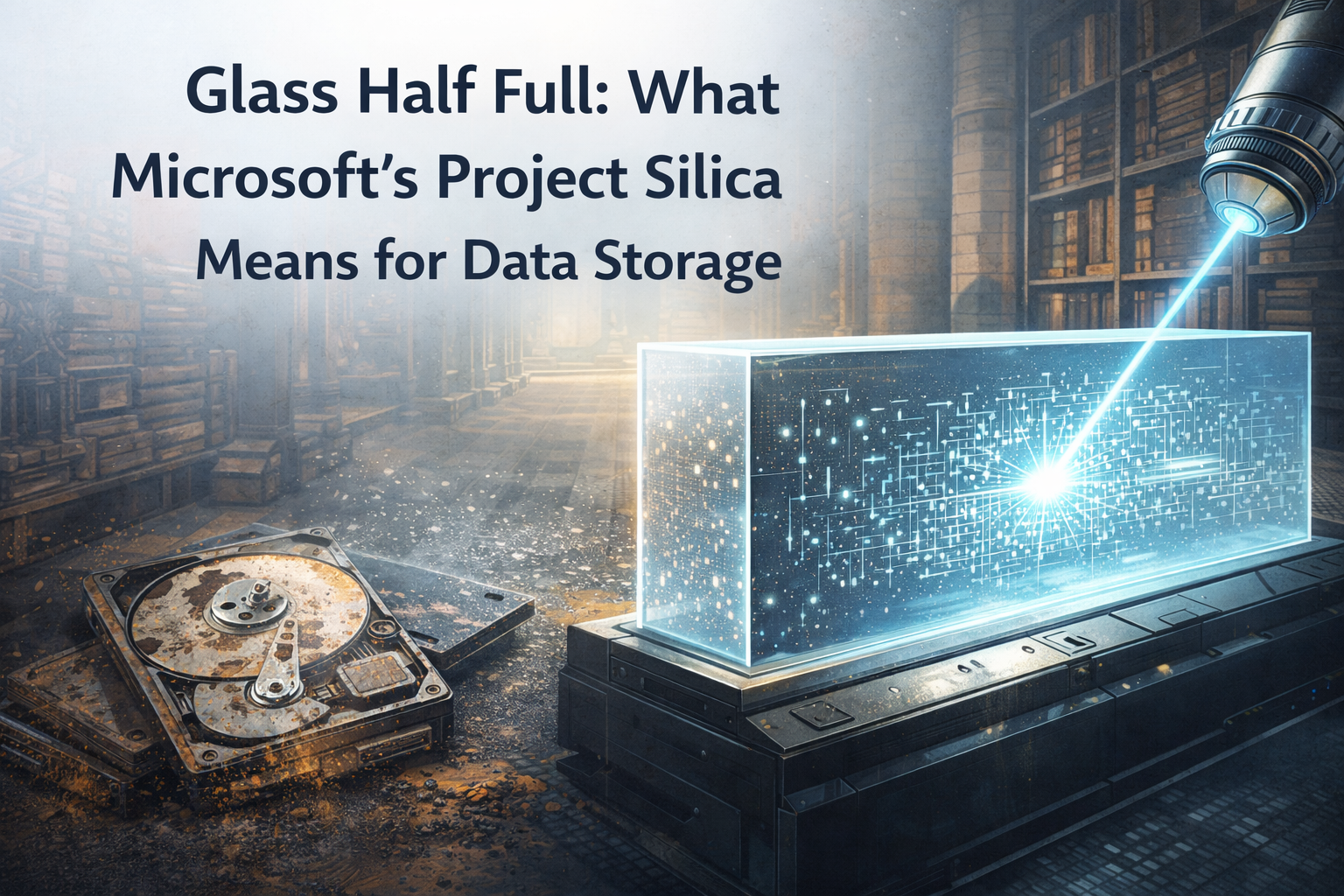
Femtosecond lasers encode information as voxels — microscopic 3D pixels — layered inside the glass itself. The data isn’t on the glass. It’s in it. Heat, water, and electromagnetic interference don’t touch it.
The prototype: 7 TB on a slab the size of a DVD. The recent breakthrough: Microsoft replicated the writing process using borosilicate glass. It’s cheaper, widely available, and already sitting in most kitchens in the form of Pyrex. That’s a meaningful step toward something manufacturable.
The precision required to do this is extraordinary. That precision is also exactly what makes it hard to scale.
What Is the Use Case for Project Silica?
Microsoft’s stated goal is permanent storage, or as close as physics allows.
Their documentation keeps returning to the same pain point: media migration. Every 5-10 years, you copy data from aging HDDs and SSDs onto new hardware. That cycle is expensive, labor-intensive, and introduces failure risk every time you run it. Project Silica would extend storage lifespan by a factor of 1,000 or more. If it reaches broad adoption, media migration becomes a legacy problem.
That’s a significant “if.”
The technology works. The 7 TB prototype is real. The borosilicate replication is real. What isn’t real yet is a path to mass production at a price point that makes sense outside of highly specialized use cases.
The organizations that should be tracking this now: national libraries, genomic research institutions, film preservation archives, government records bureaus, intelligence agencies. Any operation that writes data once and needs it intact for decades has a use case that maps directly onto what Project Silica offers. Everyone else is watching from the sidelines for now.
The question isn’t whether this technology works. It’s whether companies can build the infrastructure to support it at scale. What will that cost?
Could This Be in Production, and What Does That Look Like?
Microsoft has been working on this publicly since around 2016. The borosilicate breakthrough in 2023 was real progress. The most optimistic commercial deployment estimates put early production somewhere in the 2030s, assuming two problems get solved: read/write speed and cost.
The femtosecond laser writing process is extraordinarily slow compared to any conventional storage. A modern SSD can write 7 TB in hours. Writing glass storage can’t come close to that.
The laser systems that write glass storage cost hundreds of thousands of dollars per unit. The optical systems needed to read voxel-encoded data aren’t market-ready. There is no USB-C interface for a glass slab, and no manufacturer has announced plans to build one.
The benchmark for cold archival storage right now is tape. Tape writes fast and costs nearly nothing per terabyte. Glass writes slowly and costs significantly more per terabyte. Until that equation changes, glass stays in the lab or in niche deployments where the cost is justified by the stakes.
The resource constraints compound the timeline problem. Specialized optical engineering talent is a small pool. The software required to encode, decode, and manage voxel-layered data at scale doesn’t exist in any commercial form.
Over the next few years, the big customers will be sovereign archives, classified government records, genomic data banks, and high-value write-once repositories. These are all institutions where data loss is catastrophic, volumes are manageable, and budget exists to absorb premium infrastructure costs. Broad enterprise adoption is a decade away at minimum.
How Would Project Silica Storage Fit Into Hardware Lifecycles?
The storage itself isn’t something that hardware resellers should expect to see for sale, given the nature of this technology. It’s designed to transcend storage hardware lifecycles, not just evolve them. So the rare organizations that will deploy the silica glass storage won’t want to wipe it anytime soon.
There will be scenarios where glass storage needs to be wiped and destroyed, but the existing compliance and data governance standards aren’t written with glass in mind.
There’s no easy method to perform a data wipe either. All the ruggedness makes it resistant to electromagnetic destruction. As it stands, the best bet is to simply shatter the device. But what does a sufficiently shattered and destroyed glass slab look like?
The NIST hasn’t told us yet.
Wait and See, but Plan Ahead
You don’t need to answer the difficult questions that come with glass storage right now, but those questions are still worth asking. Early adopters of this technology will benefit from its stability and consistency. They’ll just need to update their storage best practices and data governance regulations.
This technology isn’t market ready, but you can still prepare for it. Identify any storage that you can offload to this technology, and execute when glass storage hits the market. Just make sure you’re sure before the data is set in stone – or in this case, glass.

 Dutch
Dutch  English
  German
  Spanish
  French
  Swedish