

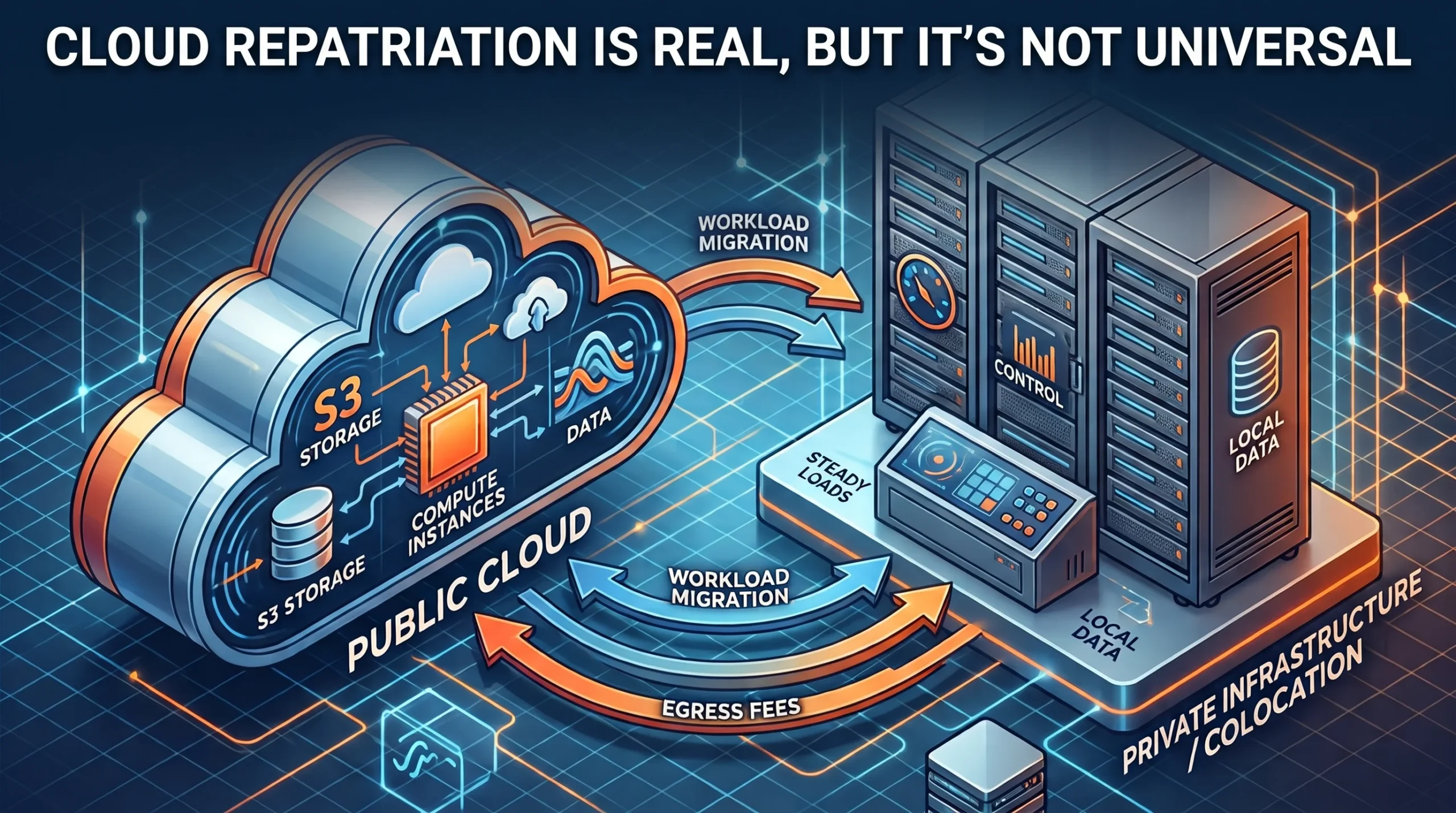
In 2016, Dropbox engineers started pulling roughly 500 petabytes of user data off Amazon S3, batch by batch, and moving it into colocation facilities the company built and leased itself. Two years later, the result showed up on page 66 of Dropbox’s IPO filing: $75 million in cumulative operating savings, disclosed to investors as proof the company could run its own infrastructure cheaper than Amazon could run it for them.
Most organizations can’t match the exact savings of Dropbox, but the math behind it is showing up on ordinary infrastructure budgets everywhere now.
Cloud repatriation, the process of moving workloads from public cloud back to on-premises or private infrastructure, has gone from a fringe argument among skeptical CTOs to a mainstream line item. The pricing model that made the cloud a bargain for a scrappy startup no longer makes sense once a workload’s size and behavior stabilize.
Fast Facts: What You Need To Know About Cloud Repatriation
- Cloud repatriation moves workloads from public cloud back to on-prem, colocation, or private infrastructure.
- It’s not an exodus. The cloud still has legitimate use cases, and most organizations maintain some of their workloads there.
- Around 80% of enterprises plan to repatriate some workload within a year. Full exits stay near 8-9%.
- As a rule of thumb: steady, predictable workloads save money on-prem. Bursty workloads still belong in the cloud.
- Egress fees are a top repatriation trigger, sometimes $50K-$500K a year for data-heavy workloads.
The Movement Towards Cloud Repatriation Is Industry-Wide
Barclays’ CIO survey found that 83-86% of enterprise IT leaders planned to move at least one workload back to private infrastructure.
There’s significant interest in cloud repatriation, but it’s not a true exodus. The survey measured intent to move some workload, not an exit from public cloud entirely. IDC’s separate research puts full repatriation, meaning a company leaving the public cloud altogether, at only 8-9% of enterprises. Gartner still expects public cloud spending to keep growing double digits through 2026.
Flexera’s State of the Cloud research found that 37% of enterprises had moved at least one workload back to private infrastructure in the prior 24 months, up from 14 percent in 2022. It’s a notable uptick, but it’s more about workload-by-workload recalibration. That doesn’t reflect companies fully leaving the public cloud behind.
Why Cloud Repatriation Is Increasingly Attractive For Businesses
Public cloud pricing reflects its ability to scale for quick, unpredictable spikes. Just pay for it and the provider can spin it up (and then back down when usage normalizes). This makes public cloud perfect for high variance workloads.
Here’s the problem for public cloud providers: most enterprise workloads don’t behave that way. A core database, an internal analytics pipeline, and a batch job that runs every night at the same volume are all steady-state by nature. Running a steady-state workload on pay-as-you-go infrastructure means you’re paying for scale flexibility that you simply don’t need.
Egress fees, the cost of moving data out of a cloud provider’s network, have become the single most cited trigger for repatriation analysis. Data-intensive workloads have reported annual egress costs between $50,000- $500,000, and those charges often show up retroactively as data volume grows past the original baseline.
Training and inference on GPU clusters is expensive at cloud rates, and moving large training datasets in and out of cloud regions creates its own bottleneck, sometimes called the data gravity problem. Teams running sustained GPU workloads increasingly want colocated or on-premises clusters where they control access and aren’t competing for spot-instance capacity.
What Actually Belongs Back On-Premises And What Doesn’t
Not every workload is a repatriation candidate, so don’t treat this as an all-or-nothing decision.
| Workload trait | Better fit for public cloud | Better fit for repatriation |
| Traffic pattern | Bursty, seasonal, unpredictable | Steady-state, consistent volume |
| Data movement | Low egress, mostly internal | High-volume transfer in and out |
| Compliance profile | Standard, no residency requirement | Data sovereignty or industry-specific mandate |
| Team’s existing skills | Cloud-native, limited sysadmin depth | Established on-prem or hybrid ops team |
| Growth trajectory | Unproven or highly variable | Forecastable over 12-36 months |
Gartner’s own modeling puts average savings from a successful repatriation at roughly 32% of a workload’s annual infrastructure cost. That factors in hardware amortization, colocation fees, and the operational overhead of running it yourself, but it only applies to workloads that align with the column on the right.
This is why the debate isn’t really about fully cloud versus fully on-premises. It’s hybrid by default. Gartner projects 40% of enterprises will run hybrid compute architectures for mission-critical workflows by the end of 2028, up from just 8% a few years earlier.
Cloud Repatriation Budgeting And Logistics
Repatriation trades a monthly cloud invoice for a capital expenditure. You need servers, opslagen netwerkapparatuur, and you need it sized correctly before the workload moves.
A cloud bill scales with usage in real time, but running workloads on-prem requires hardware purchase based on the capacity you’ll need eighteen months from now. Underbuy and you’re back to cloud bursting for overflow. Overbuy and you’ve recreated the exact overprovisioning problem cloud was supposed to solve.
Ask these questions to guide your decision making:
- Do you actually have the operational depth? Public cloud abstracts away patching, networking, and hardware failure. Repatriation means your team, or a managed provider, owns that again.
- What’s your real total cost of ownership over 3 years? Include power, cooling, colocation fees, and the refresh cycle on the hardware itself, not just the purchase price.
- Have you priced egress for the reverse migration too? Moving data out of your current cloud environment to bring it home carries the same fee structure you’re trying to avoid.
- What happens to the equipment you’re replacing? Companies moving to hybrid architectures often have existing on-prem gear sitting decommissioned from an earlier cloud-first push. That equipment has resale value that can offset part of the new build. exIT Technologies can help you capture that value when you liquidate that gear.

 Dutch
Dutch  English
  German
  Spanish
  French
  Swedish