

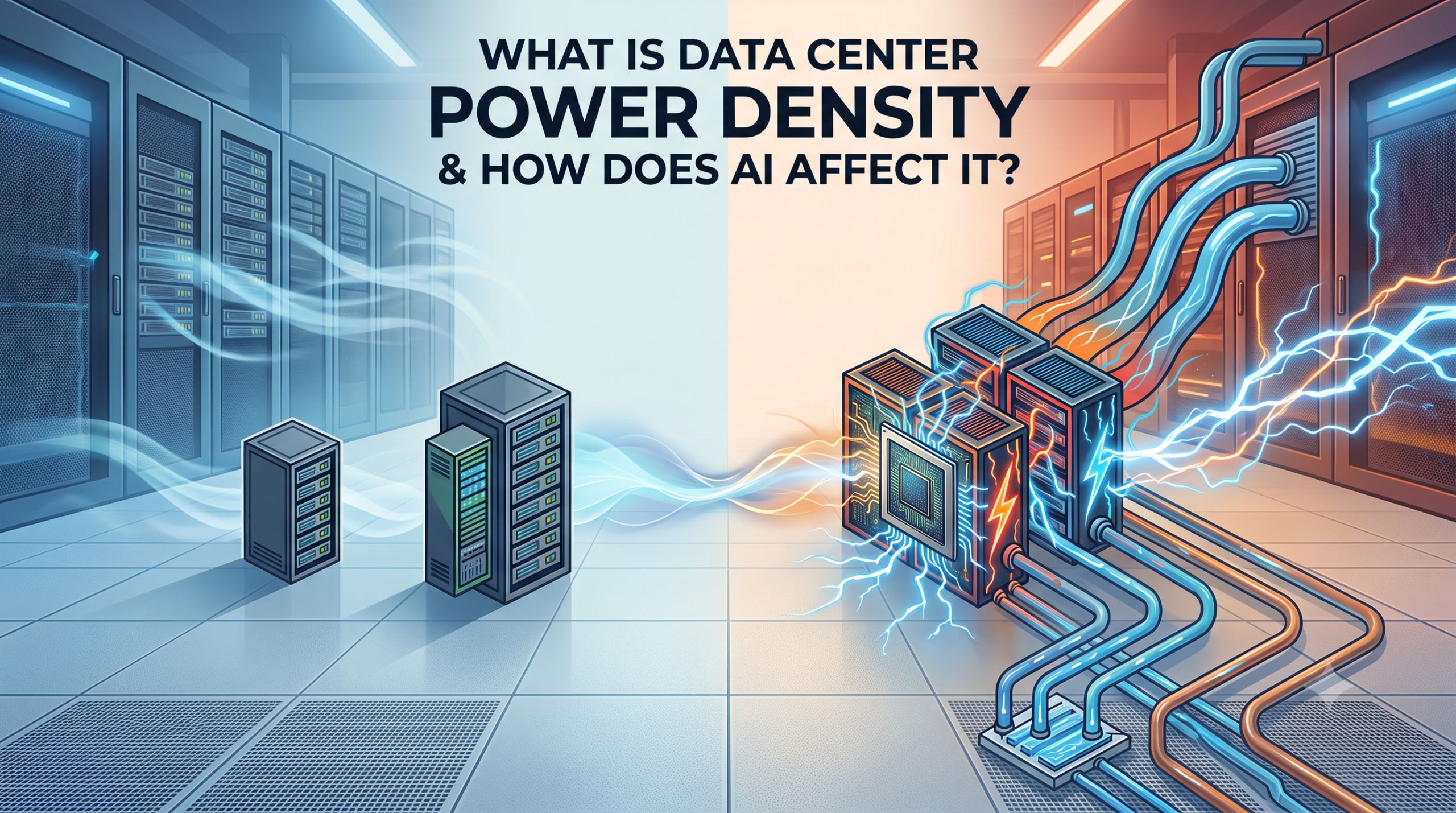
Comparing a 2019 data center with a 2026 one, you’d notice the different cooling architecture, the new model names on the servers, and the bulging power whips and busways. All these changes are directly tied to the increase of power density in data centers.
Older facilities that don’t have to worry about AI workloads can slowly scale capacity and power density up as demand increases. Hyperscalers need to push the limits of how much power a facility can realistically draw.
The demand for high power density workloads in data centers has not slowed, so data center operators need to plan for data center power density increases. The extent they need to plan for expansion depends on the workloads they run, the existing cooling systems, and access to sufficient grid power.
Fast Facts: What You Need to Know About Data Center Power Density
- The jump in data center power density is driven by GPU-based AI compute, where chip-level power draw has outpaced facility design assumptions.
- Average data center rack density has risen from roughly 4-5 kW a decade ago to 8-9 kW today, according to Uptime Institute’s Global Data Center Survey.
- High-density AI racks are already running at 130+ kW, with next-generation systems projected at 240 kW and beyond, per Schneider Electric.
- Air cooling can’t keep up past roughly 30 kW per rack. Direct-to-chip liquid cooling adoption has held flat at 22% for two years running, even as demand for it grows.
- Despite the boom in power dense racks, 82% of data centers have no racks about 30 kW, according to the Uptime Institute.
What Is Data Center Power Density?
Power density is the amount of power a fully populated rack draws, measured in kilowatts per rack. It’s a measure of how much heat and electrical load is concentrated in one physical footprint. It doesn’t measure square footage or server count, but if you combine power density with those factors, they will provide a full picture of data center power usage.
A 10 kW rack and a 130 kW rack can occupy the identical floor tile. The difference is entirely in what has to happen around that tile:
- How much power distribution feeds it
- How much cooling capacity removes the heat it generates
- How much structural and electrical headroom the surrounding facility needs to support it.
Why Power Density Matters More Than Total Facility Power
Two facilities can draw the same total megawattage and face completely different engineering problems, depending on how that power is distributed across racks.
A facility running 200 racks at 5 kW each carries a total IT load of 1 MW. Concentrating that same load into 20 racks would require 50 kW per rack, placing the same power draw into one-tenth as many rack positions and creating a much more concentrated cooling challenge. The heat has to go somewhere fast, and conventional perimeter air cooling was never built to move it.
A significant majority of data centers don’t have to worry about 50+ kW racks, but new construction from hyperscalers is almost exclusively high power density. Uptime Institute estimates that roughly a third of operators are already building new capacity specifically to handle high-density cabinets, which tells you where the market is headed even if the current installed base hasn’t caught up.
Why Is Power Density Trending Upward?
The short answer: GPUs, not general-purpose servers, are setting the pace now.
Traditional enterprise compute has grown steadily but predictably. AI training and inference hardware has not.
NVIDIA’s rack-scale systems bundle dozens of GPUs into a single interconnected unit specifically because tighter integration improves training performance, and that integration is what drives the power number up so significantly. The NVL72’s 132 kW is a feature, not a bug. It’s the direct result of packing 72 GPUs (among other components) into one rack to minimize the latency between them.
Vertiv projects AI rack-level density will climb from roughly 50 kW to 1 megawatt between 2024 and 2029. Whether every operator needs a megawatt rack is a separate question.
Here’s what’s not in dispute: the trajectory. Each GPU generation from NVIDIA has shipped with a higher per-rack power envelope than the one before it, and facility design has to react to that roadmap.
The result is a market splitting into two tiers.
On one side, you have hyperscalers and AI-focused colocation providers are racing toward triple-digit kilowatt racks. On the other side, you have traditional enterprise data centers that are still sitting in the 8-9 kW range, with no near-term reason to move.
What Does Increasing Density Mean For Data Center Infrastructure?
Air cooling has a ceiling, and most operators are already near it.
Perimeter and in-row air cooling systems generally lose effectiveness somewhere around 30 kW per rack. Past that point, moving enough air fast enough to pull heat out of the cabinet stops being physically practical.
That’s why direct-to-chip liquid cooling has moved from a niche deployment to the default conversation at any density above 30 kW. It currently accounts for roughly 22% of cooling deployments among surveyed operators, a number that has held flat for two consecutive years, even as 61% of operators say they’d consider adopting it.
That gap between rising demand and flat adoption is the real story about infrastructure and power density. The technology is proven, but retrofitting power distribution, plumbing, and structural support into an existing facility is slow and expensive.
Keep in mind that hybrid cooling, which employs air cooling in low power density areas and liquid cooling in the high power density areas, is the dominant approach. This puts an even greater emphasis on understanding data center power density so you can architect your data center with the optimal cooling approach.
Higher density also compresses the useful life of the infrastructure built around it. Power distribution units, busways, and cooling systems sized for a 10 kW average don’t gracefully absorb a 130 kW rack. They get replaced, not upgraded.
That has direct consequences for refresh cycles: the hardware supporting yesterday’s density assumptions becomes obsolete faster than its depreciation schedule assumes, and it comes offline in bulk when a facility finally makes the jump to next-generation racks.
When a facility upgrades to support higher-density racks, the servers, PDUs, and cooling equipment sized for the old density don’t get repurposed. They get decommissioned, usually in volume, usually on a tighter timeline than anyone budgeted for. If that transition is on your roadmap, exIT’s data center decommissioning services handle the logistics, chain of custody, and data sanitization for exactly that kind of large-scale infrastructure turnover.

 Dutch
Dutch  English
  German
  Spanish
  French
  Swedish