

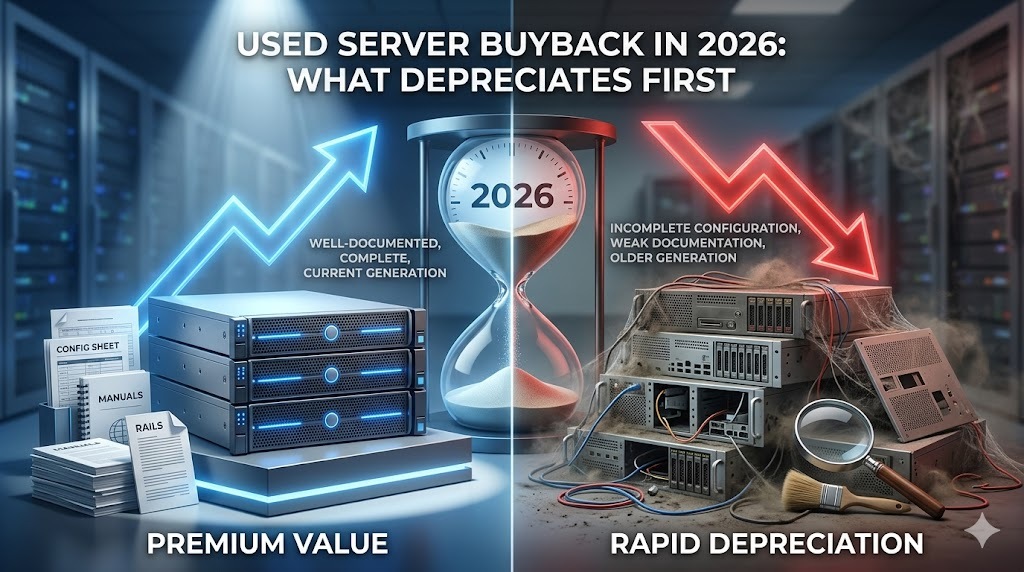
Er zijn veel manieren om gebruik te maken van oude servers, maar er is één grote fout die u moet vermijden: het wachtspelletje.
Hoe langer die servers in een doos zitten, hoe meer hun waarde daalt. Het beste is om te weten wat je spullen waard zijn op de secundaire markt en als de deal die je krijgt je bevalt, sluit je snel.
Premiewaarde voor terugkoop server komt alleen als de server een probleem sneller oplost dan de alternatieven.
Een schone enterprise box van de huidige generatie kan nog steeds goed verkopen op de secundaire markt, terwijl een ouder of incompleet systeem snel in waarde daalt. De koper geeft niets om je herstelmarges, dus ga het proces niet in met de oorspronkelijke stickerprijs in gedachten.
Klanten vergelijken het met wat ze nu kunnen kopen, hoe snel ze het kunnen implementeren en hoeveel onzekerheid ze moeten absorberen.
Oudere apparatuur moet opboksen tegen de huidige verwachtingen van wat een topklasse serverkast kan bieden.
De secundaire servermarkt heeft niet de nieuwheidspremie
Sommige tech-verkopers herinneren wat de server kostte toen de voorraad krap was, de configuratie actueel was en het platform er nog uitzag als een langetermijnstandaard.
De markt is niet zo nostalgisch.
Het eerste dat afneemt is meestal de premie die verbonden is aan het feit dat je in de buurt van de top van de mainstream onderneming zit. Denk aan de waardevermindering van een automodel uit 2026 nadat het model uit 2027 is uitgebracht, of het moment dat je ermee wegrijdt.
Zodra de koper kan overstappen op een nieuwer DDR5- en PCIe 5.0-platform of een CPU-generatie met een betere efficiëntie, daalt de marktwaarde. Het verdwijnt niet, het stopt alleen met het vragen om dezelfde kortetermijnpremie.
Dit is ook de reden waarom wachten een veilig gevoel kan geven terwijl het de verkoper toch geld kost.
De server kan nog steeds perfect bruikbaar zijn. De premie die verbonden is aan het zijn aan de top van de markt is verdwenen.
Als je servers een rommeltje zijn, verwacht dan geen top dollar
Verwarring zal de doorverkoopprijs altijd drukken. Vergelijk een goed gedefinieerd en werkbaar systeem met een onduidelijke verzameling spullen.
| Goed gedocumenteerd systeem: Een gebruikte server met informatie over model, CPU, geheugen, schijf, RAID, rail, behuizing en voeding is één ding. | Dubbelzinnig perceel: Een PowerEdge-partij of gemengde HPE-inventaris met zwakke configuratiedetails is een andere. De tweede maakt van de koper een archeoloog. |
De onzekerheid schaadt de prijs onmiddellijk.
Als de volgende operator moet uitzoeken of de server het waard is om gekwalificeerd te worden, of de geheugenpopulatie bruikbaar is, of de dragers en rails compleet zijn, of dat de doos gestript is voor verzending, dan daalt de waardering snel. En dat is nog voordat iemand zich in de specificaties verdiept.
Incomplete systemen schrijven meestal sneller af dan oudere maar goed gedocumenteerde systemen. De meeste kopers willen zekerheid, meer dan oogverblindende rekencapaciteit.
Prestaties zijn belangrijk, maar compatibiliteit is cruciaal
Zakelijke kopers kopen niet alleen computers. Ze kopen risicotolerantie.
Als een server nog steeds een duidelijke plaats heeft in test-, virtualisatie-, back-up-, edge-, branch- of kostengevoelige productierollen, kan hij in beweging blijven zelfs nadat hij zijn toppremie verliest. Als het moeilijker wordt om de server te ondersteunen, moeilijker te standaardiseren of duurder per watt dan de alternatieven, wordt de groep kopers kleiner.
Prestaties zijn nog steeds belangrijk, maar kopers hebben ook een prijskaartje:
| Leeftijd platform: Hoe oud is de generatie ten opzichte van de huidige mainstream bedrijfsstandaarden? | Geheugengeneratie: DDR4 vs. DDR5 is belangrijk voor kopers die de inzetbaarheid beoordelen. |
| Energie-efficiëntie: De kosten per watt in vergelijking met nieuwere alternatieven verkleint de groep kopers. | Beschikbaarheid van onderdelen: Kan de koper gemakkelijk hardwarevervangingen en -uitbreidingen kopen? |
| Bekendheid met management: Past het platform bij de bestaande operationele kennis van de koper? | Herwerken van implementaties: Hoeveel moeite moet de koper doen voordat de doos live is? |
Wanneer servers langer hun waarde behouden
Oudere hardware zal in prijs dalen, maar de server prijscurve hangt af van meer dan alleen hoe oud het is.
| Wat houdt langer waarde | Waardoor de waarde sneller daalt |
| Bedrijfsstandaardplatforms die nog steeds netjes passen bij veelvoorkomende werklastenCompleet systemen met gedocumenteerde configuratie en consistente partijkwaliteitServergeneraties die nog steeds operationeel zinvol zijn in secundaire omgevingen Merkplatforms waarvan kopers al weten hoe ze ze moeten ondersteunen | Inventaris die drie slechte eigenschappen tegelijk combineert: Oudere generatieOnvolledige configuratieWeinig documentatie Die combinatie maakt van een server een project. Projecten worden niet duurder. |
Er is een serieuze markt voor gebruikte servers, maar deze is selectiever dan veel verkopers denken.
Een serverterugkoop checklist voor verkopers
Voordat je aanneemt dat de servervloot nog steeds een sterke herstelwaarde heeft, moet je je voorraad toetsen aan de volgende factoren:
- Inzetbare systemen: Welke dozen zien er nog steeds uit als inzetbare systemen in plaats van donoren van onderdelen?
- Geschikt voor werkbelasting: Welke platforms zijn nog steeds geschikt voor veelvoorkomende secundaire werklasten?
- Volledige kavels: Welke partijen hebben een volledige configuratie, rails, dragers en documentatie?
- Strafrisico: Welke systemen zullen waarschijnlijk het eerst worden gestraft op generatieleeftijd, geheugengeneratie of ondersteuningscomplexiteit?
- Timing vóór het afstapelen: Wat wordt er beter als we verkopen voordat de de-rack de inventaris verandert in een gemengde partij?
Dat zijn de vragen die waarde beschermen.
Wat de wederverkoopwaarde van een server het snelst doet afnemen
De premie die nieuwe serverhardware met zich meebrengt, wordt het eerst afgeschreven, maar het is ingewikkelder dan een binaire vergelijking tussen nieuw en oud. Je moet nadenken over het vertrouwen in de markt.
| Platform Valuta: Vertrouwen dat het platform nog steeds actueel genoeg is om enterprise workloads te draaien | Volledigheid van de configuratie: Vertrouwen dat de configuratie compleet is. |
| Inzetbaarheid: Vertrouwen dat de koper het kan inzetten zonder het verhaal eromheen te reconstrueren. | Eerlijke prijzen: Vertrouwen dat de verkoper goed genoeg begrijpt wat er in het rek zit om het eerlijk te prijzen. |
De markt voor het terugkopen van gebruikte servers is in 2026 nog steeds heel reëel. Te lang wachten is meestal een fout van waardebeheer in plaats van een technische fout.

 Dutch
Dutch  English
  German
  Spanish
  French
  Swedish