

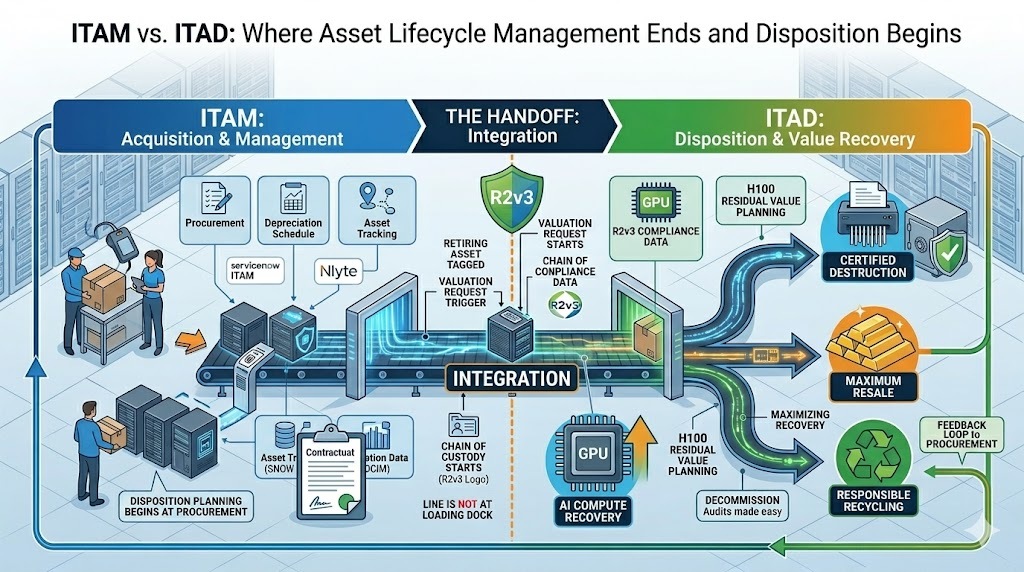
Most IT asset management programs are built around acquisition. Procurement workflows, tagging protocols, and depreciation schedules are oriented around getting assets in and keeping track of them while they’re useful.
Disposition is treated as the endpoint: a handoff, a line item, a vendor call when the refresh is already approved.
That framing is expensive and focused solely on the IT asset management (ITAM) perspective.
A real ITAM framework needs to consider ITAD and the end of each device’s lifecycle from the beginning. If you aren’t combining these processes, you’ll leave value on the table from:
- Missed remarketing windows
- Recovery yields tanked by poor condition data
- Longer and less precise decommission projects
- Compliance risks stemming from incomplete data
Operating with a gap between lifecycle management and disposition planning is a revenue and risk problem with a measurable dollar value.
Fast Facts: Where Does ITAM End And ITAD Begin
- ITAM ends the moment an asset is tagged for retirement. ITAD begins at that exact moment, which means the quality of your ITAM data directly determines the quality of your disposition outcome.
- DCIM platforms like Nlyte, Device42, and ServiceNow ITAM track physical location, configuration, and utilization. That data is the input to every ITAD decision. If it’s stale, then your disposition is too.
- Disposition planning belongs in the procurement conversation. If you’re buying 200 NVIDIA H100s today without a plan for what happens to the A100s they replace, you’re already behind.
- Most organizations treat ITAD as a cleanup task. The ones who treat it as a value recovery function get meaningfully different financial outcomes.
- The overlap between ITAM data quality and ITAD recovery value is not a soft correlation. It’s direct.
The Line Between ITAM and ITAD Is Not Where Most People Think It Is
ITAM is the practice of tracking, managing, and optimizing IT assets across their operational life. It covers procurement, deployment, software licensing, maintenance contracts, and utilization. Tools like ServiceNow ITAM, Flexera, and Device42 are the platforms most large organizations use to run it.
ITAD is what happens when those assets reach end-of-life: decommissioning, destrucción certificada de datos, valuation, resale, or recycling.
The common assumption is that ITAD starts when IT sends an asset to the loading dock. The reality is ITAD planning starts long before that. Ideally, you’re planning about the hardware lifecycle and disposal timeline from the moment you purchase brand new IT equipment.
The organizations that recover the most value from disposition don’t treat ITAM and ITAD as adjacent departments. They treat them as a continuous process with a single data layer underneath. When an asset enters the ITAM system, its eventual disposition is already anticipated. When it exits, the ITAD vendor already has the information they need.
What does that look like in practice? When a data center manager at a cloud provider decommissions a rack of Dell PowerEdge R750s, a well-run ITAM system already knows the asset’s original purchase date, current book value, maintenance contract expiration, and physical location down to the rack unit. The ITAD vendor walks in with that data already in hand. The audit is a breeze thanks to the documentation.
Anything with value will get marked for resale. Anything without value is easy to flag and send off for recycling.
DCIM And ITAM Tools Can Work Together
Data Center Infrastructure Management (DCIM) platforms and ITAM tools often overlap in scope, but they solve different problems. Understanding the distinction matters when you’re trying to build a disposition pipeline from your existing data.
DCIM platforms, like Nlyte, Sunbird, Vertiv’s TRELLIS, are designed around physical infrastructure: power draw, cooling capacity, rack space utilization, and network topology. They tell you what’s in the data center and how much power it’s consuming. They’re the authoritative record of the physical environment.
ITAM tools are designed around financial and contractual asset management: what you own, what you paid, when contracts expire, and what the book value is at any given point. ServiceNow ITAM and Flexera operate here.
Neither one on its own gives you a complete disposition picture.
A DCIM record tells you that a server is in Rack 14, Row C, consuming 400 watts. It doesn’t tell you the server is 47 months into a 48-month depreciation schedule and has $8,000 in resale value that evaporates when the next refresh hits. An ITAM record tells you the book value and contract status but may not know the physical location has changed since the last audit.
The organizations that use both, and integrate them, are the ones who will have the easiest time with an ITAD decommission or migration. The integration isn’t glamorous. It usually means building a data export that connects asset tag IDs across both systems. But the operational payoff is real.
If your DCIM and ITAM systems aren’t talking to each other before you call an ITAD vendor, expect to log some serious hours doing the data reconciliation your systems would have done automatically.
When ITAD Should Enter the Procurement Conversation
When your infrastructure team purchases 150 NVIDIA H100 SXM5 GPUs for a new AI training cluster, there are three things they know on day one:
- The purchase price
- The expected performance lifecycle, typically 18–24 months in AI compute environments
- The fact that those GPUs will eventually need to come out.
What they may not know is a disposition plan, or what the A100s they’re displacing are worth on the secondary market right now.
H100 residual values move significantly in 12-month windows. The organizations that built disposition timing into their GPU procurement decisions in 2023 recovered materially more per unit than the organizations that ran their gear to functional end-of-life and discovered the market had moved. That means planning refreshes before the next-generation Blackwell architecture hits volume availability.
The same logic applies to server hardware. HPE ProLiant and Dell PowerEdge units have predictable resale curves. An organization that tracks those curves through its ITAM system and plans refresh timing with secondary market value in mind can ensure they’re maximizing their recovery rate. An organization that treats “equipment age” and “resale timing” as unrelated variables can’t guarantee the same.
Procurement conversations need one additional question: what is the disposition plan for what this purchase is replacing, and when does it need to happen to maximize recovery value?
That question, asked consistently at the procurement stage, is the functional difference between ITAD as a cost center and ITAD as a value recovery function.
Where the ITAM Data Gaps Actually Cost You
The most common breakdown point in the ITAM-to-ITAD handoff is a data hygiene failure, not a technology failure.
The scenarios that create the worst disposition outcomes are predictable:
| Data Gap | What It Costs at Disposition |
| Inaccurate physical location records | ITAD vendor spends days on physical audit instead of hours; project timelines slip |
| Missing or incorrect purchase dates | Assets with resale value get recycled because their age is assumed, not verified |
| No maintenance contract visibility | Gear with active contracts gets disposed of without transfer or credit recapture |
| Inconsistent asset tagging across sites | Multi-site decommissions require manual reconciliation at each location |
| No utilization data from DCIM | Functional assets with low utilization are missed as resale candidates |
The fix for each of these is a data governance discipline that starts at procurement. That means consistent tagging, accurate location updates, contract data attached to the asset record. All that carries through to disposition.
How To Structure The ITAD Handoff With ITAM Data
At the point an asset is flagged for retirement in your ITAM system, via end of depreciation, contract expiration, or refresh trigger, the ITAD process should activate automatically.
That means three things in practice.
First, the retirement flag in your ITAM system should trigger a valuation request, not just a work order. Your ITAD vendor should receive the asset’s age, configuration, and quantity data before the decommission date is set, so they can tell you whether the timing is optimal for secondary market recovery.
Second, chain of custody documentation should start at the ITAM record, not at the loading dock. R2v3-certified disposition requires a documented chain of custody from the point an asset leaves operational use. If your ITAM system doesn’t record the retirement date, the retiring team member, and the handoff to the ITAD vendor, your compliance documentation has a gap.
Third, the disposition outcome should feed back into your ITAM system. What did each asset recover? What was destroyed versus resold? That data makes your next procurement conversation sharper, because now you have actual recovery benchmarks instead of estimates.
The companies that run this loop (procurement informing disposition planning, disposition outcomes informing procurement) treat ITAD as a business function with a measurable return, not a box to check and be done with.
The questions worth asking before your next refresh:
- Does your ITAM system know what your ITAD vendor needs?
- Does your ITAD vendor know your ITAM system well enough to tell you when to move?

 Spanish
  English
  German
  French
  Swedish
  Dutch
Dutch