

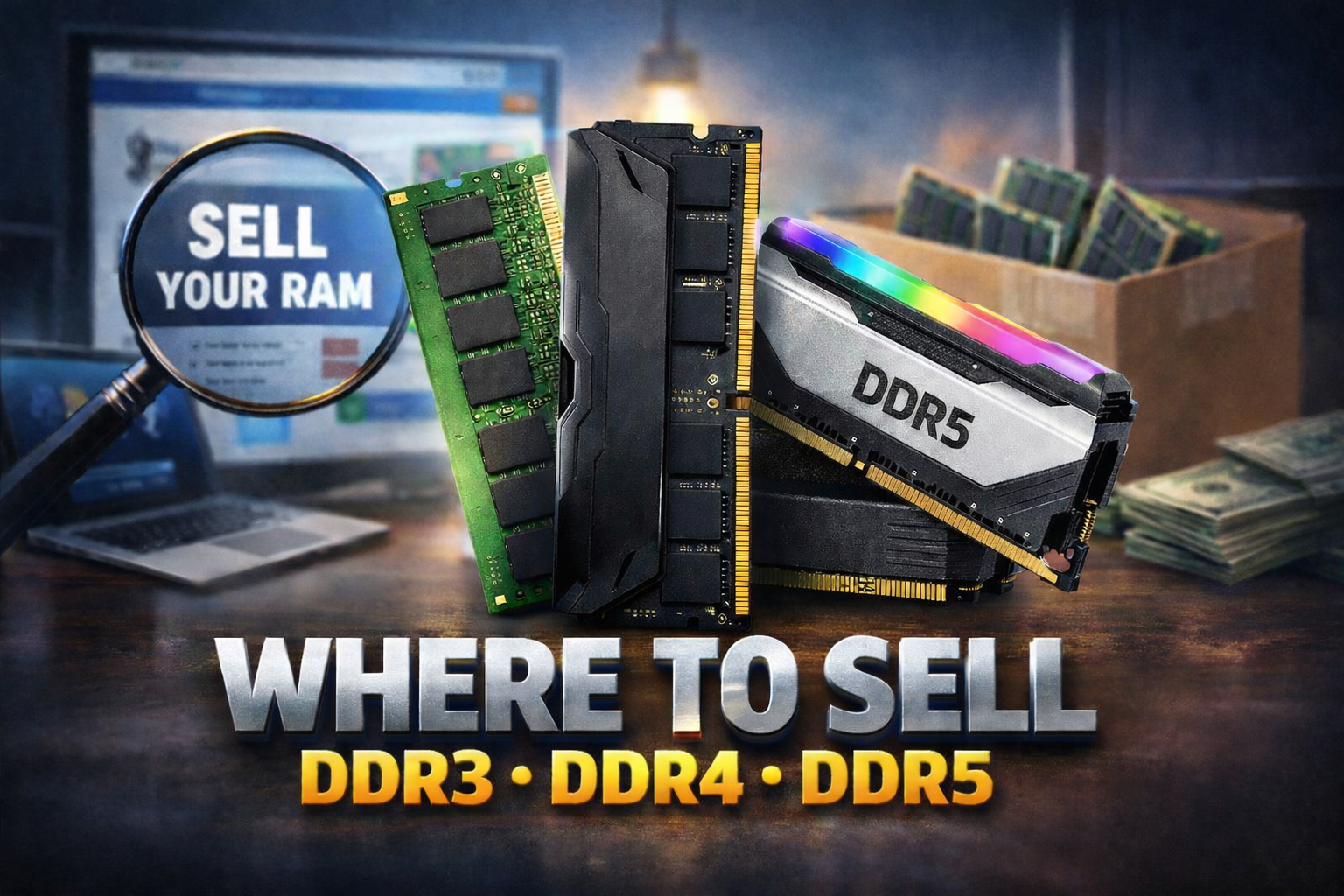
Whether you’re decommissioning a data center, refreshing enterprise servers, or simply upgrading your workstation, this comprehensive guide covers every option for selling DDR3, DDR4, and DDR5 memory: from ITAD companies to consumer marketplaces, with current 2025 pricing data and expert recommendations.
🚀 2026 Market Alert: RAM Prices at Historic Highs
DDR4 memory prices have surged 100-140%+ since early 2024 due to AI infrastructure demand and major manufacturers shifting production to DDR5. Samsung, SK Hynix, and Micron have cut DDR4 output to approximately 20% of 2024 levels. Combined with Windows 10 end-of-life (October 2025) driving massive PC refresh cycles, now is an exceptional time to sell used memory.
Current RAM Resale Values (December 2025)
Understanding current market values is essential before selling your memory. Prices vary significantly based on DDR generation, capacity, speed, and whether the RAM is consumer (desktop/laptop) or enterprise (ECC server) grade.
| RAM Type | Retail Price | Buyback Range | YoY Change |
|---|---|---|---|
| DDR4-3200 16GB (Desktop) | $80-120 | $40-75 | +140% |
| DDR4-3200 32GB Kit | $160-220 | $80-140 | +135% |
| DDR4-3200 32GB ECC (Server) | $250-320 | $120-200 | +100% |
| DDR5-5600 64GB ECC (Server) | $500-600 | $200-400 | +85% |
| DDR5-6000 32GB Kit (Desktop) | $350-450 | $150-280 | +242% |
| DDR3-1600 8GB (Desktop) | $25-40 | $10-25 | +50% |
| DDR3-1600 16GB ECC (Server) | $40-60 | $15-35 | +40% |
| Scrap/Non-Working RAM | — | $20-40/lb | Stable |
Note: Server/ECC memory (highlighted) commands significant premiums over consumer RAM. Prices current as of January 2026 and subject to market fluctuations.
Have Enterprise Memory to Sell?
Get a competitive quote within 1 business day. exIT Technologies buys DDR3, DDR4 & DDR5 in bulk with free shipping and fast payment.
Get Your Free Quote →Best Places to Sell RAM Memory in 2026
The right selling channel depends on your quantity, timeline, and whether you need compliance documentation. Here’s a comprehensive comparison of all major options:
| Plataforma | Best For | Fees | Payment Speed | Minimum |
|---|---|---|---|---|
| Empresas ITAD | Enterprise bulk | Ninguno | 1-5 days | $500-2,500 |
| eBay | Maximum individual price | 13.25% | Variable | Ninguno |
| r/hardwareswap | Enthusiasts | ~3% (PayPal) | 1-7 days | Ninguno |
| Mercado de Facebook | Local cash sales | None (local) | Immediate | Ninguno |
| Amazon Trade-In | Convenience seekers | Ninguno | 2-5 days | Ninguno |
| Local Recyclers | Non-functional/bulk scrap | Ninguno | Same day | By weight |
1. ITAD Companies (Best for Enterprise)
Best for: Bulk enterprise memory, compliance requirements
IT Asset Disposition (ITAD) companies specialize in purchasing used enterprise hardware in volume. For organizations decommissioning servers or refreshing data center infrastructure, ITAD providers offer the fastest, most secure path to monetizing surplus memory.
If you have surplus inventory from a data center decommission or a hardware refresh, the most efficient way to maximize your return is to sell used ram to a certified ITAD partner that offers competitive bulk pricing and secure logistics.
No fees, free shipping, compliance documentation (R2v3, certificates of destruction), single transaction for bulk lots, payment via wire/check/crypto, handles all logistics.
⚠️ Considerations:Minimums apply ($500-2,500+), prices are wholesale (not retail), testing period before payment (3-7 days typical).
2. eBay
Best for: Individual sellers wanting maximum price
eBay remains the largest marketplace for used computer components. Individual RAM modules can fetch retail prices, but sellers must invest time in listings, shipping, and customer service.
Highest potential prices, global buyer pool, price transparency via completed listings, established trust system.
⚠️ Considerations:13.25% seller fees, shipping costs, time investment, return/fraud risk, payment holds for new sellers.
3. Reddit r/hardwareswap
Best for: Enthusiasts, fair prices, quick sales
The r/hardwareswap community offers a knowledgeable buyer base that understands RAM specifications. Transactions are peer-to-peer with PayPal Goods & Services protection.
Lower fees (~3% PayPal), knowledgeable buyers, fair market prices, active community, reputation system.
⚠️ Considerations:Requires Reddit account history, must follow posting rules, limited buyer protection, US-focused.
4. Mercado de Facebook
Best for: Local cash transactions
Facebook Marketplace connects you with local buyers for in-person transactions. Best for sellers who want immediate cash without shipping hassles.
No fees (local), instant cash, no shipping, see buyer profile before meeting.
⚠️ Considerations:Limited to local buyers, safety concerns (meet in public), potential for lowball offers, no protection.
5. Amazon Trade-In
Best for: Convenience, Amazon shoppers
Amazon’s trade-in program accepts some RAM modules for Amazon gift cards. Convenient but typically offers below-market values.
Simple process, free shipping, trusted platform, no negotiation needed.
⚠️ Considerations:Gift card only (not cash), below-market offers, limited RAM types accepted.
6. Electronic Recyclers
Best for: Non-working RAM, tax benefits
Certified e-waste recyclers accept any RAM regardless of condition. Good option for non-functional modules or when tax deductions are preferable to cash.
Accepts any condition, potential tax deduction, environmentally responsible, convenient drop-off.
⚠️ Considerations:Minimal cash value ($20-40/lb scrap), requires documentation for tax benefits.
How to Identify Your RAM Type
Before selling, you need to accurately identify what type of memory you have. DDR3, DDR4, and DDR5 are physically incompatible and have different values.
Quick RAM Identification Guide
Check the Notch
DDR3: Notch closer to center. DDR4: Notch slightly off-center. DDR5: Different notch position from DDR4.
Count the Pins
DDR3: 240 pins. DDR4 & DDR5: 288 pins (but different keying prevents cross-compatibility).
Read the Label
Look for “DDR3”, “DDR4”, or “DDR5” on the module sticker. Also note capacity (GB) and speed (MHz).
Check for ECC
Server memory says “ECC”, “RDIMM”, or “LRDIMM”. These command higher prices than standard desktop RAM.
DDR3 vs DDR4 vs DDR5: Technical Comparison
| Especificación | DDR3 | DDR4 | DDR5 |
|---|---|---|---|
| Pin Count (Desktop) | 240 | 288 | 288 |
| Tensión | 1.5V | 1.2V | 1.1V |
| Speed Range | 800-2133 MHz | 2133-3200+ MHz | 4800-8000+ MHz |
| Max Capacity/Stick | 16GB (typical) | 128GB | 256GB+ |
| Current Market Status | Legacy (declining) | Mainstream (high demand) | Growing adoption |
| Resale Value Trend | Stable/Declining | Surging (+100-140%) | Premium pricing |
What Affects RAM Resale Value?
Not all RAM is created equal. Understanding what drives value helps you set realistic expectations and maximize your return.
| Factor | Higher Value | Lower Value |
|---|---|---|
| Marca | Samsung, SK Hynix, Micron, Crucial | Generic, unbranded, unknown |
| Type | LRDIMM, RDIMM (server ECC) | SODIMM (laptop) |
| Capacity | 64GB, 128GB, 256GB modules | 4GB, 8GB modules |
| Velocidad | DDR4-3200+, DDR5-4800+ | DDR3-1333, DDR4-2133 |
| Condición | Tested functional, clean contacts | Untested, visibly damaged |
| Generación | DDR4 (current sweet spot), DDR5 | DDR3 (declining relevance) |
| Cantidad | Matched sets, bulk lots | Single sticks, mixed lots |
Step-by-Step: How to Sell Your RAM
Complete Selling Checklist
- Inventory all modules: Document type (DDR3/DDR4/DDR5), capacity, speed, brand, and quantity. Use a spreadsheet for bulk lots.
- Identify RAM type: Check notch position and labels. Note if server/ECC or consumer grade.
- Test functionality (if possible): Install in a compatible system to verify modules work. Tested RAM fetches 20-40% higher prices.
- Clean contacts: Gently clean gold contacts with 90%+ isopropyl alcohol and a lint-free cloth.
- Research current values: Check eBay completed listings for retail reference. Request ITAD quotes for wholesale pricing.
- Choose your selling method: Bulk enterprise → ITAD. Individual sticks → eBay/Reddit. Local quick sale → Facebook Marketplace.
- Get multiple quotes: For ITAD sales, submit to 2-3 companies. Quotes typically valid 7 days.
- Package securely: Use anti-static bags and rigid packaging. ITAD companies often provide free materials.
- Ship and get paid: ITAD companies provide prepaid labels. Payment typically 1-5 business days after receipt.
Data Security When Selling RAM
A common concern when selling IT equipment is data security. Here’s what you need to know about RAM:
RAM is volatile memory—data is lost within seconds to minutes after power is removed. Unlike hard drives or SSDs, RAM modules do not retain data and generally don’t require data wiping before sale.
However, enterprise sellers should still maintain proper chain-of-custody documentation for compliance purposes. Reputable ITAD companies provide:
- Chain-of-custody tracking from pickup to processing
- Certificates of recycling or remarketing
- R2v3 certification ensuring responsible handling
- HIPAA-compliant processes for healthcare organizations
- Audit-ready documentation for corporate compliance
Why Enterprises Trust exIT Technologies
Enterprise Memory Liquidation Guide
For IT managers and data center operators handling large-scale memory disposal, working with a certified ITAD company streamlines the process while ensuring compliance.
What to Look for in an ITAD Partner:
- R2v3 Certification: The industry standard for responsible electronics recycling
- Chain-of-custody documentation: Tracks assets from pickup through final disposition
- Insurance coverage: Protects against liability during transport and processing
- Flexible payment options: Wire transfer, check, PayPal, or cryptocurrency
- Free logistics: Prepaid shipping labels and packing materials
- Transparent pricing: Clear quotes with no hidden fees
- Fast turnaround: Quotes within 1-2 business days, payment within a week of receipt
Preparing Enterprise Memory for Sale:
- Export inventory from asset management system (model numbers, quantities, locations)
- Coordinate decommissioning timeline with ITAD provider
- Obtain quote and verify insurance/certification documentation
- Schedule pickup or prepare shipment with provided materials
- Receive payment and certificates upon processing completion
Ready to Sell Your Enterprise RAM?
exIT Technologies offers competitive pricing, free shipping, and payment within days. Submit your inventory for a no-obligation quote.
Get Your Free Quote →Preguntas frecuentes
RAM values vary significantly by type, capacity, and condition. In 2026, DDR4 prices have surged due to AI demand and production cuts. Desktop DDR4-3200 16GB modules typically fetch $40-75 at buyback, while server ECC memory commands premiums—64GB DDR5-5600 ECC modules can be worth $200-400+ depending on brand and condition. Check the pricing table above for current market rates.
DDR3 (240-pin) operates at 1.5V with speeds up to 2133MHz—it’s legacy technology with declining value. DDR4 (288-pin) runs at 1.2V with speeds from 2133-3200MHz+ and is currently the market sweet spot with high demand. DDR5 (288-pin but different keying) operates at 1.1V with speeds starting at 4800MHz—it’s the newest standard with growing adoption and premium pricing. Each generation is physically incompatible with others.
No. RAM is volatile memory, meaning data is lost within seconds to minutes after power is removed at room temperature. Unlike hard drives or SSDs, RAM modules do not retain data and generally don’t require data wiping before sale. However, enterprise sellers should still maintain chain-of-custody documentation for compliance purposes.
Look for R2v3 (Responsible Recycling) certification as the industry standard for electronics recyclers. e-Stewards certification indicates the highest environmental standards. ISO 14001 covers environmental management, while ISO 9001 addresses quality management. For data-sensitive industries, verify HIPAA compliance for healthcare data and NAID AAA certification for data destruction.
Minimums vary by buyer. exIT Technologies has a $2,500 minimum total value (which can include other IT equipment like servers, CPUs, or drives). Some ITAD companies accept from $500. Consumer marketplaces like eBay, r/hardwareswap, and Facebook Marketplace have no minimums—making them better for individual sellers with just a few sticks of RAM.
Yes. Some ITAD buyers accept non-working RAM at reduced prices. Electronic recyclers purchase any RAM regardless of condition for precious metal recovery (gold, palladium)—expect $20-40 per pound for scrap memory modules. BuySellRam and some other buyers specifically accept damaged and non-working modules.
Payment timing varies by company and payment method. exIT Technologies typically pays within 1-2 business days of receipt via wire transfer, check, PayPal, or cryptocurrency. Most ITAD companies pay within 3-7 days after testing and verification. Consumer marketplaces are immediate upon sale, minus any payment hold periods for new sellers.
RDIMM (Registered DIMM) includes a register chip that reduces electrical load on the memory controller, enabling higher capacity configurations in servers. LRDIMM (Load-Reduced DIMM) takes this further with additional buffering, allowing even higher capacities (up to 256GB per module). Both are ECC server memory and command higher prices than standard UDIMMs. LRDIMMs generally have the highest resale value due to data center demand.
Turn Your Surplus Memory Into Cash
exIT Technologies has been helping Fortune 500 companies, data centers, and IT departments monetize used hardware for over 30 years.
Get a Free Quote Today →

 Spanish
  English
  German
  French
  Swedish
  Dutch
Dutch