

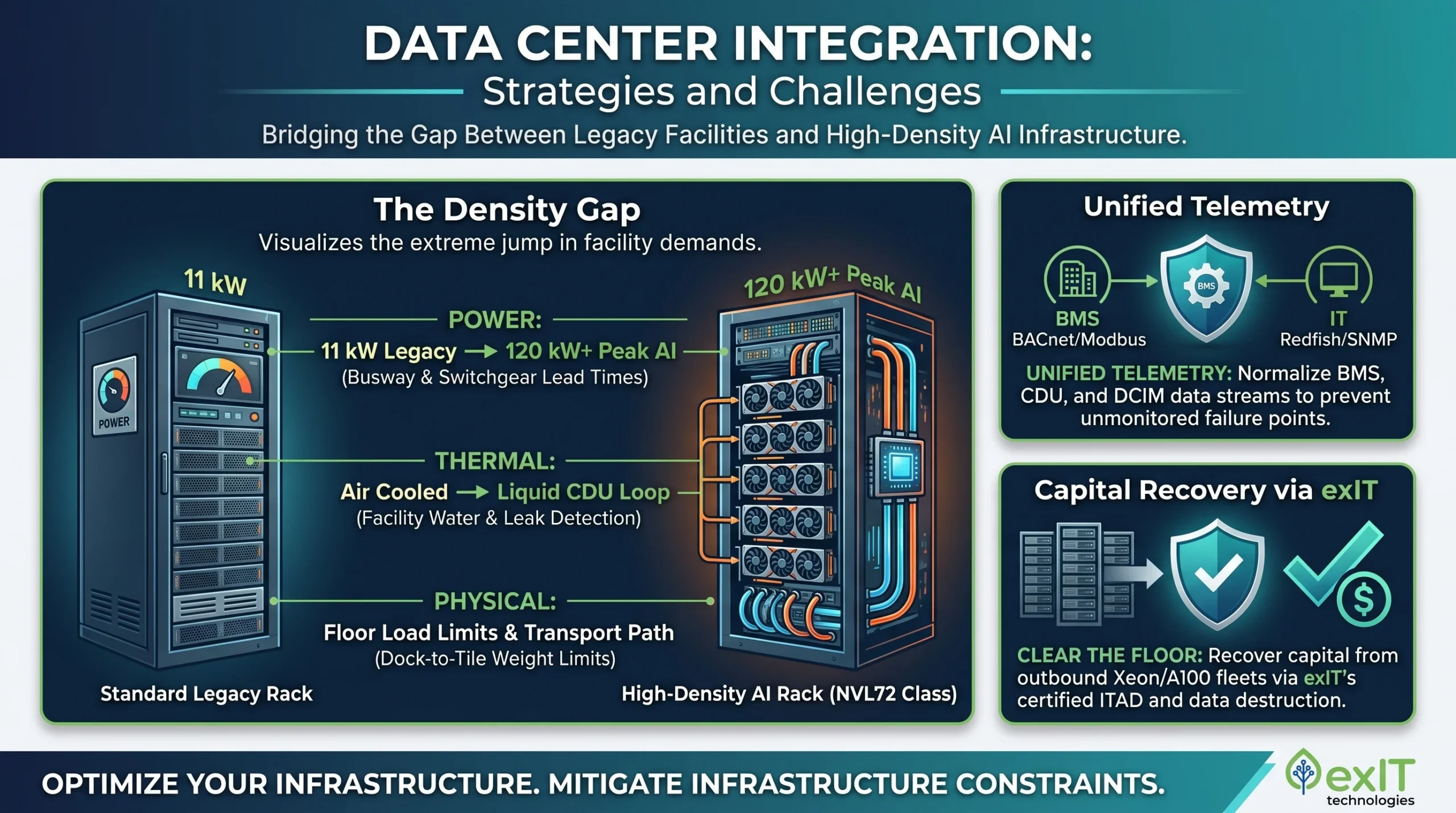
Data center integration is the work of making new hardware, facility systems, and management software run as one environment inside a building that’s already operational.
Vendors still sell it as a compatibility exercise between servers, storage, and network gear. The compatibility problem that actually stops projects sits between the equipment and the room.
Uptime Institute’s 2026 global survey puts the average modal rack density at just over 11 kW, and at 7.8 kW once you strip out a small group of new high-density sites. A single NVIDIA GB200 NVL72 draws roughly 120 kW. That gap encapsulates the challenges of a data center integration.
Fast Facts: What You Need To Know About Data Center Integration
- Integration in an existing facility needs to focus on power, thermal, and structure before software.
- Uptime’s 2026 survey puts typical rack density at 11 kW. HPE specifies the GB200 NVL72 at 132 kW nominal with a peak electrical design power near 192 kW, and tells operators to size busways for the peak.
- Air cooling stops being viable somewhere above 30-40 kW per rack, so integration now includes a facility water loop, a coolant distribution unit, and a leak response procedure.
- Facility systems speak BACnet and Modbus. IT systems speak Redfish and SNMP. The CDU sitting between can lead to single-pane monitoring plans.
- Every kilowatt, square foot, and floor tile the new gear needs is already allocated to hardware that is still racked and still spinning.
How Rack Density Drives Data Center Integration
Data centers have centered on a 4-5 kW rack design density for more than a decade, and Uptime reports that band is still the most common one in deployment. Rooms built to that number have busways, breaker coordination studies, and floor loading assumptions that all agree with each other. One 120 kW rack breaks undermines the entire architecture.
HPE’s QuickSpecs for the NVL72 list 132 kW nominal thermal design power, split as 115 kW removed by liquid and 17 kW removed by air. Peak electrical design power runs about 1.5 times nominal, near 192 kW, and HPE’s guidance is to provision the busway for the peak rather than the nominal. One rack, provisioned properly, wants more capacity than an entire legacy row.
This is why “we’ll add AI capacity to the existing floor” turns into an electrical project with a nine-month lead time on switchgear.
The Four Failure Points Of Data Center Integration
Integration failures almost always fall into one of four categories: power, thermal, physical, and telemetry.
| Failure category | The spec sheet | The building | Question you need to answer |
| Potencia | 132 kW nominal, roughly 192 kW peak, 50 V DC bus bar inside the rack | Busway sized for a 5 kW row, coordination study from 2014, no spare panel positions | Which panel feeds it, and what goes dark while the tap is landed |
| Thermal | 115 kW to direct-to-chip liquid, 17 kW to air | Chilled water loop with no secondary side, no CDU, no leak detection under the floor | Where facility water connects, and which team owns the loop during off hours. |
| Physical | 600 mm wide, 1,068 mm deep, 2,495 mm high, ~3,245lb | Raised floor tiles rated near 250 kg each, a freight elevator with a posted limit, door frames from the last build-out | The measured path from dock to tile, including turning radius |
| Telemetry | Redfish from the IT stack | BACnet/IP and Modbus TCP from the BMS, with CDU alarms living somewhere else entirely | Which system holds the alarm that pages a human |
Floor loading is most likely to get overlooked until it’s too late. A GB200-class deployment often arrives as separate crates for the compute rack, the switch rack, the CDU, and the power distribution. Each of these elements have their own weight and route to the tile. Your plan needs to reflect that from the start.
Data Center Monitoring Requires IT and Facility Integration
Your building management system may communicate over BACnet/IP and Modbus TCP, while your servers expose data through Redfish, SNMP, or a legacy interface like IPMI. The CDU adds a third source of telemetry, usually Modbus, though newer units may also support BACnet, SNMP, Redfish, or an API. Getting all of that into one DCIM platform takes native integrations, protocol gateways, or another translation layer.
Plan that integration instead of assuming it. DMTF added Redfish models for CDUs, cooling loops, coolant connectors, and other thermal equipment starting in 2023, and support keeps expanding. Redfish compatibility still does not guarantee that your CDU, BMS, and DCIM platform will communicate natively.
Before deployment, verify which protocols each system supports, how you will normalize the data, and which platform owns the alarms.
This matters more once monitoring data stops living on a dashboard and starts driving decisions. Uptime Institute’s 2026 survey describes growing complexity for data center operators as AI and high-density infrastructure expand.
The same caution applies to AI. Expectations for AI’s operational benefits slipped slightly in Uptime’s 2026 survey, and operators remain more comfortable with lower-risk uses like sensor-data analysis and predictive maintenance than with handing AI more control over facility operations.
Connect the data first. Confirm you can trust it. Then decide what software gets to act on it.
After Data Center Integration, Cash In On Old Hardware
Reported server lifetimes climbed from roughly 36 to 44 months between 2015 and 2023. Since then the trend reversed, and Uptime’s 2026 figure sits near 41 months, with some operators now targeting refresh cycles under four years.
Put removal on the same schedule as installation, with dates, named owners, and a destination for the outbound equipment. Treat retired hardware as an asset with a market value and a chain-of-custody requirement rather than as debris. The Xeon nodes and A100s coming out of that row are worth real money, and their value drops every quarter they sit in a cage waiting for someone to make a decision.
If the gear coming out of that row is headed for “we’ll stack it in the cage and deal with it later,” then you’ll be paying for every day you put off the decision. See what decommissioned data center hardware is actually worth before you clear the floor.

 Spanish
  English
  German
  French
  Swedish
  Dutch
Dutch